
Matt W Cook

writer.former fundamentalist.christianly fellow

Block-Breaker

Do you hate the blank screen?  That stark whiteness that mocks you, dares you to throw some of your own petty words on it?  It taunts and jabs at you, making you muddled inside while staying pure and clean and white. And what do we say when it does that?  What do we say when it becomes hard to put words on the page?

“I have writer’s block!”

What is writer’s block?  I’m not really sure.  I think we mean that deep feeling of resistance, even revulsion, to writing.  It’s not that we don’t have good ideas.  We just can’t give birth to them.  It hurts.  We push and push, but create nothing new.

I think most people like me (i.e., people who write but had never been paid a cent for it) are pretty sure that writer’s block is just something that you have to deal with.  Work around it, maybe.  Wait until it goes to sleep.  But we never really hope that it will be destroyed altogether.

Suddenly, though, I think we’ve been thinking wrong.  You want to know why?  I think I just killed it.

If you read ten books on writing by ten successful writers, you’ll have ten different opinions on how to get into your flow and create.  Many of them contradict each other, and they all swear by what they do.  I tried every one of them.  And none of them worked.  Especially the ones I thought sounded the best.  So the blocks got worse.  Every time I sat down at a large project, it got harder and harder.  Heck, I hadn’t written anything of consequence on my large project for half a year.  Stuck.

And then I made my own way.  And writer’s block vanished in a puff of smoke.

It’s been two weeks since I started this new way of doing writing.  And I haven’t been stuck yet.  Some days are harder than others, of course.  But I’ve never, ever sat in front of a blank screen and kissed despair.  I’ve never thought of giving up.  I’ve churned out 1000+ words every single session.  Average session time: 2 hours.  I made my own way.  It works.  You know why it works?  Because it’s right for me.  It’s made for me.  Stephen King’s way works for him, but it killed me dead when I tried it.

Freedom in whatever you are pursuing is not a carrot in front of a donkey.  It’s possible.  It’s real.  You can level up.  As a writer, I feel like I’ve gone from level 1 to level 2.  And I have the distinct feeling that I can’t go backwards.  So whatever you’re trying to do, keep trying it.  Don’t listen to people who tell you how things need to be or the struggles you’ll always have.  You may not always have them.  You may win.  Why not?  I’ve just started winning.

var addthis_pub=”4a0af351783743a8″;
Bookmark and Share

This is second-hand unless you’re reading it at http://www.theilliteratescribe.com
Laughing at Yourself

Why you should never take yourself seriously

  • You have a bellybutton.  And those are funny.
  • The characters in a comedy are always better off than characters in a soap opera.
  • No one else takes you seriously.  Why should you?
  • When you take yourself too seriously, you tend to take God less seriously.  And that’s no good.
  • You’re small, flawed and insignificant.  Best not to be too serious about that.
  • People who can laugh at themselves are way more happy than those who cannot.
  • There is little in you that is worth taking seriously.
  • There are too many serious issues in the world for you to waste serious-energy on yourself.
  • People who take themselves too seriously are never free from the horrid tyranny of trying to be cool.
  • People who take themselves too serious can never, truly, be themselves.

var addthis_pub=”4a0af351783743a8″;
Bookmark and Share

This is second-hand unless you’re reading it at http://www.theilliteratescribe.com

Family Day

Someone recently asked me what sort of traditions we have for Family Day in Canada. Since it’s a brand-new holiday, though, I didn’t have an answer. But it got me thinking. What sort of traditions should we try to implement for Family Day? Here’s some ideas:

  • Drive around with the whole family and get yourself completely lost.  Then try to find your way back.  To make this a little more exciting, get the kids to direct you back.
  • Have a dress-up party with your family.  Once you have the wildest costumes, turn it into a dance party.
  • Take the family to the nearest downtown urban center and hand out good things to the homeless and the lonely.
  • Find a town you’ve never been to before.  Take the family there, walk around, have lunch and go back home.
  • Make it a day of wild photos.  Drive around aimlessly and stop wherever you find a neat looking place to take a family portrait.
  • Build a fort.
  • Have the kids cook whatever they want for dinner.
Any more ideas?
var addthis_pub=”4a0af351783743a8″;
Bookmark and Share

This is second-hand unless you’re reading it at http://www.theilliteratescribe.com

Coffee

I was driving to work this morning and my thoughts drifted toward coffee shops. I remember that great coffee shop we used to go to while I was in KLBC. Sometime troops of ten or more would piles into cars and get down to that wonderful place. And we’d spend hours talking and laughing and building friendships that, to this day, I consider some of the strongest I’ve ever had. That coffee shop wooed me into falling in love with coffee shops.

These days, though, I feel like coffee shop culture is changing a little. Or maybe it had started changing back then, but since Peterborough was a bit of a different kind of town, I didn’t notice. Or maybe I didn’t notice because I’m a dummy. Whatever.

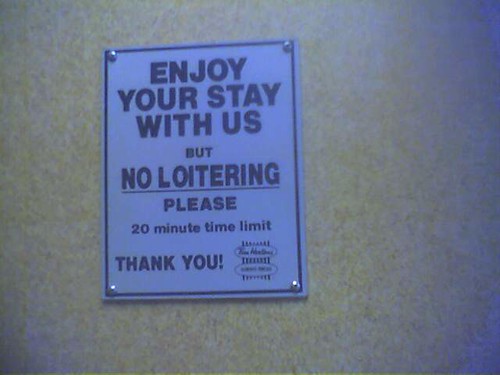
Tim Horton’s is the first example. Each one is a little different, but there is one thing that is the same in each and every one. That unwelcoming sign posted on the wall that says they love your patronage, but only for thirty minutes. As much as I love Timmy’s, this sign has always been a bit of an insult to me. It seems to defy the culture that coffee shops were made to cater to. That culture that delights in sitting around and talking and loving. With that sign on the wall, I feel like I’m in a coffee assembly-line.

But then there’s Starbucks. Everyone either loves or hates them. There hadn’t been many of them when I first went to Pakistan, and now they’re all over the place. Being an aspiring writer, and hearing that all real writers need to write in public so people can see them write, I’ve sat there a few times with my computer. The Good: You can sit there all day long and no one will ever bother you or give you a funny look. You belong there. The Odd: Coffee Chop Culture is still defied there. I’m actually sitting in a Starbucks right now. You know who else is with me? Three other people with laptops, hoping we will watch each other write. A man sitting along with a gourmet cookie. A woman with an infant. That’s it.
I’ve destroyed coffee shop culture.

Coffee Shops used to be places to build relationships. Now it’s a place for fake writers to fake write. I feel cold.

Next time I need to get out of the house to write, I’m going to do it in the library. Coffee Shops are meant for people, not projects.

var addthis_pub=”4a0af351783743a8″;
Bookmark and Share

This is second-hand unless you’re reading it at http://www.theilliteratescribe.com

Some Quizzes – Part 2

Okay, part two of our little quiz.

Scenario 4
In a sadistic game worthy of the comic books, an evil super villain has kidnapped your son and one hundred strangers from a distant land. Your son is placed in a box. The strangers are placed in another box (a big one, I suppose). You are given a control panel that connects to explosives on box boxes. There are two buttons on the control panel. One will detonate your son. One will detonate the strangers. If you do not press one of the buttons, bot boxes will explode. Whoever does not die will walk free.

What is the right thing to do?
  • Save the hundred strangers
  • Save your son
  • Let them both die

Scenario 5
35 million people will die of hunger-related illness this year. $500, well placed, could prevent one of these deaths. You have a house, a car, a good job and a nice church building. How many deaths ought you to prevent and to what lengths ought you to go to prevent them?
Answer in comments.

Scenario 6
Jesus told you that you are the salt of the earth (meaning you are meant to slow down the decay of the world like salt slows the decay of meat) and the light of the world (meaning you are meant to shine the glorious light and love of Jesus in a dark world). Given $1000, how could you best accomplish these roles in your present situation?
Answer in comments.

Is it just me, or are moral scenarios easier when they are in the abstract and aren’t actually happening every day?

var addthis_pub=”4a0af351783743a8″;
Bookmark and Share

This is second-hand unless you’re reading it at http://www.theilliteratescribe.com

Some Quizzes – Part 1

I was reading a neat article in Maclean’s about the changing moral culture of Canada. So I decided to throw a little poll at you, my readers, and see what our morality looks like. Here we go!

Scenario 1
You have just purchased a $900 suit and are proudly wearing it as you walk down the street.  It’s the most perfect piece of clothing you’ve ever worn and you’ll probably nail that job interview you’re on your way to all because of it.  Suddenly, you notice a small child playing in the middle of the street and a car bearing down on top of her.  If you act now, you will be able to push her out of the way.  But in doing so, you’ll almost certainly ruin your new suit.

Are you morally obligated to save the child?
  • Yes
  • No
  • Undecided

Scenario 2
You’re walking down that same street and you see a different child playing and another car bearing down on her.  But the car is going so fast that, while you’d certainly be able to save the child, you calculate that you’ll have a 50% of being wounded and a 50% of being seriously wounded.  Seriously = losing a limb or getting paralyzed for life.

Are you morally obligated to save the child?
  • Yes
  • No
  • Undecided

Scenario 3
You are the only wealthy man in a poor village.  Five children from your village have been kidnapped by a group of people demanding $100,000 for their return.  Your security forces assure you that there is no way of getting the children back without paying the ransom.  But, they say, if the ransom is paid they are sure they can apprehend the kidnappers as well.  But, through some strange twist of reasoning, the money will not be returned.  You are the only person in the village with the means of paying the ransom, but you’d probably have to sell some of your favorite things to do so.

Ought you to pay the ransom?
  • Yes
  • No
  • Undecided

That’s enough for today!  Answer the polls and discuss.  Part 2 tomorrow.

var addthis_pub=”4a0af351783743a8″;
Bookmark and Share

This is second-hand unless you’re reading it at http://www.theilliteratescribe.com

The Lemon

What happens when you offer Joseph a quarter to take one bite of a lemon? He goes all out. Here’s the video:

var addthis_pub=”4a0af351783743a8″;
Bookmark and Share

This is second-hand unless you’re reading it at http://www.theilliteratescribe.com

Tell Me a Story

Stories are important to me.  You want to know why?  I’ll tell you.

  1. Stories can hold a lot more meaning and truth in a shorter form than mere preaching and info-dumps.
  2. Stories are an expression of the creative spark that God placed in every human.
  3. Stories can preserve, proclaim and process Truth.
  4. Jesus told stories.  Much of the Bible is devoted to stories.
  5. Stories, when properly enjoyed, are more fun than TV, movies and video games put together.
  6. Stories are able to tell us many things about many subjects in a very short time.
  7. Stories exercise our creativity.
  8. Stories last forever.
  9. Stories, when written well, can be a powerful force for good.
  10. I like stories.

var addthis_pub=”4a0af351783743a8″;
Bookmark and Share

This is second-hand unless you’re reading it at http://www.theilliteratescribe.com

The End of Wellness

End of the month! End of Wellness?

I started the project as a way to find out what would happen if I lived well. The biggest thing I learn, however, is that wellness is complicated. It’s also kinda simple.

It’s simple in that the steps to wellness are relatively clear.  If I eat right, live right, socialize right and love right, things will turn out right.  It’s complicated in that I seriously don’t want to do any of that.  Resistance is a tough enemy.

So now that the challenge is over, I find myself faced with the question of how I’m going apply all of this to my life.  I think I’m just going to try to stay well.  Moderation will come back into play, which will be nice, because I missed some things.  But I’m going to try to keep my eye on wellness.  Because things did  turn better when I lived better.  I dropped the ball many times throughout the month (perhaps because I tried to throw out moderation).  And that added guilt on top of the stress of it all.  Hopefully with moderation instead of severe regulations, that can be taken care of.

Conclusion: We were made to live in a certain way.  When we try to live that way, things tend to turn out better.  Yay for wellness.

var addthis_pub=”4a0af351783743a8″;
Bookmark and Share

This is second-hand unless you’re reading it at http://www.theilliteratescribe.com

Task 117

A guest post from Ruth.

   “My people do not understand!” laments God at the opening of the book of Isaiah. Oxen know their masters and donkeys know their master’s beds, but the people of God simply do not understand. Throughout the first chapter of the book God calls his people evildoers, whores, dishonest and murderers. But why?
   A glance at history and you’d be tempted to think the people of Israel were doing okay. God himself admits that they were faithful in the different rituals that had been laid down to him. They observed the sabbath and all the other special days and gave the offerings they were commanded to give. They were quite religious. So what was the problem? What was so bad that God was prompted to command them to stop being faithful to the religious code he’d given them (Is. 1:13)?

      Learn to do good;
   seek justice,
      correct oppression;
   bring justice to the fatherless,
      plead the widow’s cause
         Is. 1:17

   Here is the matter’s heart. All the slick religious duties in the world could not compare to the glorious simplicity of love and justice.
   The word plead is a neat one in Hebrew. Usually it’s used as argue, contend or quarrel. I’m no Hebrew scholar (more’s the pity), but it seems that you could legitimately translate that last bit as ‘Fight for the widow.’

   In the West, most of the offerings brought into the church are used on projects that directly benefit the people giving the money. It’s usually on something that has to do with the church building or on whoever is doing the preaching. I wonder, though, if this is the way it was meant to be. A quick look through the New Testament will show that most money donated to the church went immediately and directly to the poor and the helpless. This urge to help the helpless was so great that the early church often considered it fraud to spent it on anything else (see this great article for more info on how the early church spent its money).
   So if the example of the early church and the words of Christ and the Apostles are telling us to spend Jesus’ money on the poor, why are we spending it all on preachers and real estate?

   I’m from Pakistan. My mother is a widow. I suppose I have a bit of a bias view of things. But I’ll tell you something about widows in Pakistan. There is hardly anyone in my country who is of lower social standing than a widow, especially in my people-group. The widow is ignored, forgotten and tossed aside. Most of the ones I know have one outfit and spend their days working themselves into the grave, bent over in hot fields. They are mistreated. They are abused. And no one fights for them.

   I’m going to fight for them. I regret I didn’t see the need before my mother became a widow. But I see it now and I’m donning my gloves and entering the battle. If no one else will plead the widow’s cause, I will.
   Will you fight, too?

   We’ve set aside a special bank account.  Anything that goes in there is Jesus’ money.  I can only use it for things I think Jesus would use it on.  For now, that’s widows.  The vision may broaden as time goes on, but it’s a widow’s purse for now.  Some of you have expressed interest in helping the widows of Pakistan.  If you want to, you can put your own funds into this widows purse.
   How will this money be used to help widows?  First, it will be used to get the necessities of life, like food and clothes.  Second, it will attempt to fund basic education for the young children that most widows in Pakistan seem to have.  I’m not a charity and I don’t know a thing about tax receipts.  And I don’t intend to, either.  This is just me giving what is surplus to those who have never had a surplus.  If you have surplus, you’re free to send a cheque my way and I promise to put it to work for widows and orphans.
   I’m going to Pakistan at the end of April. After seeing my family, my main goal is to see out the worst-off widows in my area and see, more specifically, how I can fight for them. I hope to return with great stories that I’ll be sharing at the Facebook Group, 117.

   You can help. You can pray. You can join the Facebook group that I’ve made. You can send money directly to needy widows through me. You can come with me to Pakistan, sit with widows and encourage them. There is so much that can be done. If only we, as God’s people, would understand.

var addthis_pub=”4a0af351783743a8″;
Bookmark and Share

This is second-hand unless you’re reading it at http://www.theilliteratescribe.com