Matt W Cook

writer.former fundamentalist.christianly fellow

Tag: religion

The thing about religion

The best, most exciting questions of the universe are the ones that can’t be figured out empirically.  Is there a God?  What is morality?  Who am I?  Why?  Why?  Why?

Unless I’m religious.  Then there’s a book for that.

Is there a God?  Look it up.
Who am I?  Look it up.
How shall I treat my neighbour?  Look it up.
Who can I love?  Look it up.

Even when the answers don’t make sense, with religion they are still, somehow, true.

The thing about religion is that it tries to convince me that the best questions of life, the most exciting ideas, are empirical.  That they are waiting for me in a book, if only I’d read it.

The other thing about religion, is that I’m done with it.  Finally and joyfully done.

Buddha on Doctrine

“My teaching is not a dogma or a doctrine, but no doubt some people will take it as such… I must state clearly that my teaching is a method to experience reality and not reality itself, just as a finger pointing at the moon is not the moon itself. A thinking person makes use of the finger to see the moon. A person who only looks at the finger and mistakes it for the moon will never see the real moon.”

The Buddha, c. 563 BCE – c. 483 BCE

Wisdom’s Bastard Children

We criticize folks from other religions and denominations and wordviews when they have our favourite beliefs wrong.

When those people live better than us and the rest of our tribe, we mourn that they look like they understand things better than us.

But, in some direly important ways, they do understand better than us.

Because wisdom is justified by all her children.

Heroes and Villains

John Calvin was a hero, they told me.  I didn’t argue.  It wasn’t my place to argue.  It was my place to listen.  And so John Calvin was a hero.

He was clever, you see.  A pioneer of sorts.  One of the first and brightest to read the Book the way they told me it was meant to be read.  He was a hero.  Like Martin Luther.

It bothered me that he killed a man, though.  Bothered me that he thought folks who disagreed with him ought to die.  But he was a product of his culture.  He can’t be fully blamed.  He just used worldly weapons in a spiritual war.  When you put it that way, it doesn’t seem like that big a deal.

Though I bet Michael Servitus thought it was a big deal.

And, sure, Martin Luther was a misogynist and anti-semite.  Well, he was a product of his culture, too.  Can’t be too harsh on him.  Or on Jonathan Edwards for his owning of slaves for that matter.  Products of their culture.  Innocent, in their own ways.  Heroes still, I suppose.

Mother Theresa, on the other hand, was not a hero, they said.  Sure she poured herself out for the ‘least of these’.  Sure she inspired millions and eased the sufferings of countless invisible people.  But she was the wrong kind of Christian.  Roman Catholic.  Damned.  In hell, despite her service.  That’s what they said.

Gandhi is another one who isn’t a hero.  Sure, he championed non-violent resistance against the forces of evil.  Sure, he fought against oppression and violence without resorting to violence and oppression.  But, like Theresa, he was one of ‘them’, not ‘us’.  Hindu.  Blind.  Damned and in hell, despite his service.  That’s what they said.

Is it any wonder?

Is it any wonder they talk about us like they do?

Is it any wonder I felt the need to [………]?

We forgive the murderers and slave owners because they thought like we do.

We condemn the compassionate souls because of a rosary and a dash of vermillion upon the forehead.

Heroes and Villains

John Calvin was a hero, they told me.  I didn’t argue.  It wasn’t my place to argue.  It was my place to listen.  And so John Calvin was a hero.

He was clever, you see.  A pioneer of sorts.  One of the first and brightest to read the Book the way they told me it was meant to be read.  He was a hero.  Like Martin Luther.

It bothered me that he killed a man, though.  Bothered me that he thought folks who disagreed with him ought to die.  But he was a product of his culture.  He can’t be fully blamed.  He just used worldly weapons in a spiritual war.  When you put it that way, it doesn’t seem like that big a deal.

Though I bet Michael Servitus thought it was a big deal.

And, sure, Martin Luther was a misogynist and anti-semite.  Well, he was a product of his culture, too.  Can’t be too harsh on him.  Or on Jonathan Edwards for his owning of slaves for that matter.  Products of their culture.  Innocent, in their own ways.  Heroes still, I suppose.

Mother Theresa, on the other hand, was not a hero, they said.  Sure she poured herself out for the ‘least of these’.  Sure she inspired millions and eased the sufferings of countless invisible people.  But she was the wrong kind of Christian.  Roman Catholic.  Damned.  In hell, despite her service.  That’s what they said.

Gandhi is another one who isn’t a hero.  Sure, he championed non-violent resistance against the forces of evil.  Sure, he fought against oppression and violence without resorting to violence and oppression.  But, like Theresa, he was one of ‘them’, not ‘us’.  Hindu.  Blind.  Damned and in hell, despite his service.  That’s what they said.

Is it any wonder?

Is it any wonder they talk about us like they do?

Is it any wonder I felt the need to [………]?

We forgive the murderers and slave owners because they thought like we do.

We condemn the compassionate souls because of a rosary and a dash of vermillion upon the forehead.

Diversity

Diversity of culture and opinion is like genetic diversity in a population. Without it, people become stagnant and get all sorts of nasty, cancerous ideas.

Without diversity, a population has very few new and innovative ideas. Generally they just continually repackage old ideas, try to put newish labels on them, and pass them around to each other. This is why those fundamentalist religious groups always seem to be two or three decades behind the rest of the population their in. Because those kinds of places don’t mix well with people who think and act differently than they do. And the more closed-minded the religious group, the further back in time they seem to be. Walk into your local Gospel Hall if you don’t believe me. You’ll feel like you’re in 19th century Scotland. Cool singing, but pretty messed up ideas about gender roles, science and how to live life.

That’s one of the reasons I love where I’m living now. I used to live in Thorncliffe Park, a predominately Islamic area. A place where everyone kinda dressed and acted and thought the same. A place where there was not much in the way of new, ricky ideas. A place where most people did what they did so that everyone else would approve of them.

But when the population is diverse, people feel empowered to try new things. SInce everyone is so obviously unique and living life the way they think it should be lived, there is not much pressure to conform to a pre-established pattern. You’re free to live life according to your own conscience, instead of the conscience of some dead role model or abstract system.

And whose conscience should you be living according to anyway, if not your own?

I’ve lived in Toronto for almost four years. But only now am I beginning to see how wildly awesome this town is.

So here’s to diversity. I hope and pray we get butt-loads more of it and that it spreads to all those neat places where it hasn’t been welcomed before. It may be uncomfortable for a lot of people, but without it we become cultural inbreds. Slow to accept change and ill-equipped to deal with real life.

Sermons and Stuff

People often get surprised when they find out I’m a preacher.  They get even more surprised when they find out I mostly preach in evangelical fundamentalist churches.  I remember one man, when he found out I was a preacher, asked “So, you part of the Church of the Universe or something?”

Yes.  Yes, I am.

I enjoy preaching and the wicked-cool opportunity it gives me to throw ideas about love around.  And, since I didn’t have much else to say this morning, I figured I’d give you a link to the last two sermons I preached, both of them on the favourite passage of weddings: First Corinthians 13.  Love, baby.  It’s all about love.

What is Love? Pt. 1

What is Love? Pt. 2

Hope it makes you want to love more.  If it doesn’t, then one of us missed the point.

Anti-Addictions

     And just like that, my anti-addiction struck. And it struck hard.

     I’ve been addicted to a few things in my day. Some good. Some bad. I used to be addicted to cigarettes. And anyone who’s been on those will tell you that it’s not a matter of the intellect that gets you to smoke. It’s a deep, passionate and physical need. I knew it was hurting me. But the hurt from smoking was not as bad as the hurt from not smoking.

     I’m still addicted to some things. Food, for example. If I even go half a day without food, I feel a pain in my body and mind and soon it’s all I can think of. There are a few other things like that in my life. Water. Air. Third-wave ska. Stuff like that.

     But my present addictions are nothing compared to my anti-addictions.

     If an addiction is a physical / mental need to do something, then an anti-addiction is a physical / mental need to not do something. Ever had that? Here’s how it works:

     You sit down to do something very good. Maybe to paint a picture or plan a party or spend time praying or meditating or get moving on your ridiculous novel. Suddenly you feel a deep well of hate rise up within you. You look at your computer and you scowl. You can feel your whole spirit rebel against the idea of doing that good thing. It’s all the symptoms of an addiction, except it’s pushing you away. Steven Pressfield calls it Resistance. I call it a serious, life-stopping pain in the ass.

     When you feel the resistance, there are only two ways of success, so far as I can see. First, you can try to plow through and have faith that the road will clear in time and you’ll soon stop hating the thing you love. This is the best way.

     But sometimes it doesn’t work. Sometimes the resistance, strengthed by negative distractions and attidutdes, is too strong. The demons pull at your creativity and piss all over it. Some demons can’t be cast out with hard work alone. Some demons need prayer.

     I’m a spiritual person, though not really religious. And I believe in the power of mystic prayer. So when the resistance is hard, I stop. I turn off the screen. I pull my legs up and close my eyes and breathe. I let my thoughts leave as I become mindful of my breaths. In. Out. In. Out. Breathing in I calm my body. Breathing out I smile. Dwelling in the present moment, I know it is a wonderful moment.

     And my mind and heart calm. The demons stop screaming long enough for me to cup my hands to my face and utter the sacred words with deep mindfulness.

     “Our father which art in heaven,
     Hallowed be thy name.
     Thy kingdom come.
     Thy will be done on earth
     As it is in heaven.”

     And they flee. My spirit soars and touches the source. I float on the goodness of the great compassionate source of the universe.

     And when I’m done my communion I open my eyes. I can hear the story being whispered in my ear now. I say “Thank you, thank you” and take the story and put it done on paper.

     I win.

He Who Loves

     I read, many years ago, that real, lasting happiness is only found in the worship of God. John Piper calls it Christian hedonism. I latched onto this idea immediately. I had just become a Calvinist and Piper was one of my heroes. Not only that, but the concept looked sound, according to the Bible, which I viewed as a sort of instruction book for life at the time.

     So I set about trying to find happiness in the worship of God. I was told, and I believed, that the two most important ways of touching God were reading the Bible devotionally and praying.

     I gave it my all. I got up at six every morning to spend the first dark hour of the day ‘alone with God.’ I said prayers and wrote prayers and sang prayers. I tried all the spiritual disciplines. I fasted once every couple months. I preached in churches and on street corners. I studied old and new theological books. I did it all.

     None of it worked.

     Oh, I had some good times. Prayer would sometimes lift me into a deep level of connection with the divine. The Bible, especially the words of Jesus, would sometimes enrich my soul and wake up my spirit. But those times were exceptional. Rare. Adrenal, not coronary.

     It became hard, so I tried harder. I did street evangelism and vowed to become a missionary to a scary Muslim country. But that made things worse.

     I was not a hypocrite. I was honest. I honestly thought that true happiness could only be found in the ‘Christ centered’ life I was living. And that was my message as I preached in the churches and streets of Peterborough, Toronto, Welland, and, eventually, Pakistan. But I wasn’t experiencing it. I promised others that they would, and I made them believe I was. But I was mostly empty.

     I don’t know when it changed. I don’t know when I started drifting away from the evangelical Calvinism I had so loved. But I eventually came to a startling realization.

     He who loves, knows God.

     Connection to the joy-giving source of life does not come from reading holy books a certain number of times. Spirituality is not measured by how many prayers you utter in the dark mornings while the world sleeps so sinfully. It does not come through sermons or songs or having the right theology or going to the right churches or temples or mosques. It comes from love.

     And not just a general love. Not the effortless love that everyone has. Not the love that is willing to protect friends and family. It comes from the powerful, Christ-borne love that strives to protect enemies. The love that is never willing to punish, but to forgive and reconcile an infinite amount of times. The love that paves the narrow road that leads to life.

     And then what happened?

     When most people talk about their Christian journey, they usually emphasize their struggles. How they still fight against depression and sin and their commitment to live a Jesus life. How they still can’t seem to hold into the joy of God in a consistent way.

     I don’t talk like that anymore. Because my happiness is finally real. I found it buried in a field, and I went out and sold everything I had for it. I took it home and put it in my heart. I no longer experience long periods of darkness and depression punctuated by flashes of joy. Now it’s long, extended flashes of joy, once in a while punctuated with down-time. It wasn’t religion or Christianity or positive thinking that changed me. It was love. Just love. It makes many of the old songs I sang in my fundamentalist Sunday School so much more powerful than I could have ever imagined:

And I’m so happy,
So very happy,
I’ve got the love of Jesus in my heart.
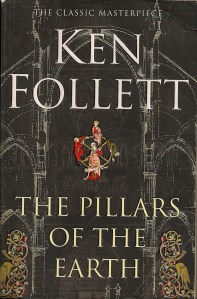
Review: The Pillars of the Earth

“The small boys came early to the hanging.”

     My mother recommended this to me ages ago. I meant to read it. Really, mom, I did. But I forgot. I picked it up recently on a whim and did not remember a thing that my mom had said about it. And I’m really glad about that. Because if I had known what it was about, I probably would have left it alone.

     The Pillars of the Earth is a historical fiction about cathedral building.

     Erm… yay?

     Let’s be honest, it sounds crazy-boring. Most churches are boring. Old churches are even more boring. Building old churches sounds so boring that I feel like poking my eye just to get a distraction. And on top of all that, the book is nearly a thousand pages long. Wow.

     I’m so very glad that I had forgotten what the book was about.

     The author, Ken Follett, grabs you by the throat in his first line. And he doesn’t let go until the book is ending. His story is huge and he gives you characters to love and hate by the handful. And then he puts those characters through the grinder. What else could you ask for in a novel?

     In the end, the novel is about the inevitability of human suffering and the unbeatable human spirit that has been slowly, painfully, but assuredly making the world a better place.

     There is something very special about the book that makes you care about something you have no interest in. I don’t care about building churches. Even big churches. But Tom Builder cared. Prior Philip cared. And since I cared about Tom Builder and Prior Philip, suddenly I cared about their big church.

     The Pillars of the Earth is a great read. Its scope is huge, dealing every human struggle from intimate marital relationships to battles between kings and popes. Pick it up. You’ll love it. I swear.