
Matt W Cook

writer.former fundamentalist.christianly fellow

Tag: bible

I believe in God (an apology)

What is God?

It’s hard to believe in God today, especially if ‘God’ means a supremely good and powerful Person who made the universe and is very concerned with the beliefs and behaviour of mortals. The texts about this god often paint him as petty and contradict what we know about ourselves and the world. Also, this god’s representatives are often no better than the folks who ignore him.
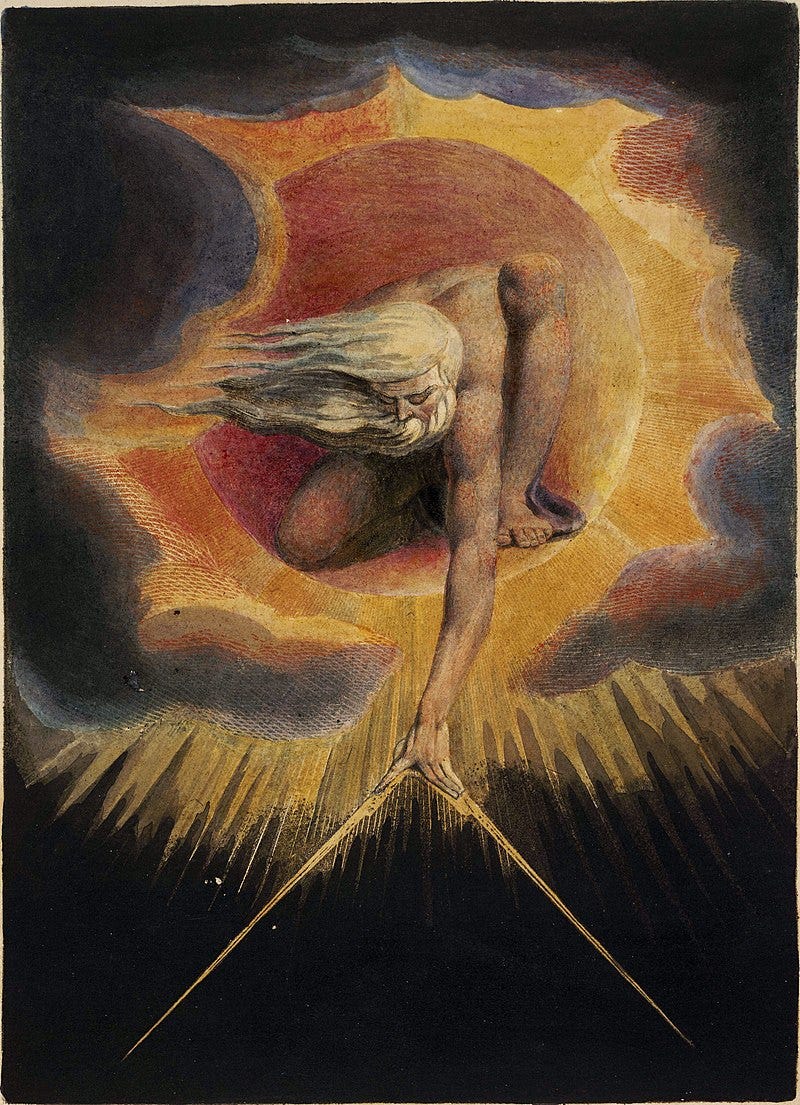
The Ancient of Days by William Blake
And it’s always a him.

If God is a craftsman, crafting a cosmos, then God must be less than Godself + God’s craft + the God-sized room within which God crafts, thus not God.

Here’s my take: God is the Infinite. The that-than-which-nothing-greater-can-be-conceived. The Alpha to Omega, A to Z, First and Last, the Beginning and the End.

God is before all things, and in God do all things consist. All things live and move and have their being in God. Everything that is, is in God, and there can be nothing outside of God. When I speak of God, I mean the single, infinite substance that constitutes the universe. If this sounds like Spinoza’s God, it more or less is.

Objections

But this God isn’t personal.

God is not a person, but that does not make God impersonal. God is not less than a person. God encompasses every past, present, and future person. So, insofar as God can be known, God can be known personally.

Because God is the sound of a tree falling in the forest; real when I hear it. God is personal when I engage in a personal relationship with God.

We make personal relationships with everything, even when we don’t mean to. When I trip on an uneven sidewalk, the stone is malicious. When I’m stuck on the highway, the traffic is evil. And this isn’t totally irrational. Consciousness must be as natural to the universe as magnetism or the strong and weak nuclear forces. Empathy (and anthropomorphism) is consciousness attempting to recognize itself. There is love here.

So, since I am a person, I crave a personal relationship with God. Religion is a way to intentionally, specifically, and skillfully cultivate a personal relationship with God. There are others.

This isn’t the God of the Bible.

The Bible does not present a unified depiction of God (thank God). Paul understands God differently than Jesus, who approaches God differently than Moses. Origen would not have agreed with Augustine who would not have agreed with Calvin or Darby or any Christian alive today. Every theologian has understood God differently, despite common heritages. This is not (necessarily) a problem.

The Bible is not a science text or a user’s manual. It is a library connecting today’s living faiths with their ancient roots, buried deep in inaccessible history. Its purpose is not to declare facts about God, but to show the depth of our inheritances and inspire us to grow forward from faith to faith, glory to glory, preparing the way for something amazing. To confess Christianity is to take our place in this ever-changing Body of faith and practice.

The Bible has its proper place in my faith: a Godsend, and useful for apologies, gospels, rebukes, and encouragements: so that the religious practitioner can be skilled and equipped for every good work.

Why Christianity?

It is my inheritance, and my children’s after me. Years of practice gave me a rather particular set of spiritual skills. Prayer still lets me talk to God, hear God, and reaffirm my best aspirations. Worship still fills me with joyful holy awe. Scripture still provides spiritual meat and drink. The Father still hides in unapproachable light. The Son is still present in the eucharist, the Body, and myself. The Holy Spirit is everywhere. You say no one is listening when I pray? I listen. And, beyond these clinging aggregates that I call myself, who knows what sapience is privy to my devotional utterings?

A Christian God

The Trinity is one of the oldest and most controversial mysteries in Christianity. Here is a way of understanding the Three-in-One:

God is Father (the Almighty)

The eternal, immortal, immutable, invisible God, sustaining the universe through the Word of His Power. God the Father is no less than the unapproachable, unchangeable laws of nature that govern the universe. The founding principle of reality. The prime substance from which all things proceed. The consistent, unalterable nature of the universe.

God the Father is unknowable, and yet I want to know God. I see something when I stare at the abyss. I hear a sound when the tree falls.

God is Son (the Word)

That sound is the Son, the image of the invisible God, the Word by which the universe comes into being. The Son is firstborn of all creation—begotten not made, co-eternal with the Father—who died and lives, forevermore. The expression of the Father, the Laws of Nature in action. If the Father is the Game, the Son is the game being played.

According to my scriptures, Jesus of Nazareth was declared to be the Son of God in power and taught his followers to likewise call God Father, becoming the eldest of many siblings. His death and literal resurrection in the people who abide in him, the Body of Christ, is one of the great mysteries that Christianity peeks into.

God is Holy Spirit (the Paraclete)

The Holy Spirit could be the biggest mystery because She’s the one by which we speak about God. Like thinking about the mind or looking at the eye; it’s hard to use a tool on itself.

The old creeds say that the Ghost proceeds from the Father, or from the Father and the Son. Jesus calls her a comforter, advocate, or helper. She tells prophets and poets what to say. She opens minds and regenerates hearts. She’s the wind that blows where it wishes, carrying us along. I think God the Holy Spirit is the infinite interplay of relationships arising from the Father and the Son. The manifestation of God’s immanence, the substance of the connection between all things on all levels. This is a mystery.

God is Love

The universe is not cold, uncaring, or trying to kill us. The Earth is a perfect fit. True, not all of it. And yes, the vacuum of space is painfully lethal, but we didn’t emerge there, did we? Despite the ways we have marred it and the fact that death comes with life, this world is friendly. The sky pours water and the earth produces food. The sun gives us warmth while gravity keeps us stable. Behold this gorgeous flesh we inherit, full of sensors that light the universe with taste and touch and sight and sound! What do we call this but the love of God?

It is right to rest in the benevolence of God because God brings me into being and keeps me that way, until this form returns to dust, making room for more of the life that God loves.

Final Thoughts

It might seem like this deconstructs God into meaninglessness. I understand if you feel this way. I would never try to supplant someone’s idea of God with my own. That’s an aggressive idolatry.

But my devotional life has flourished with this perspective. If you find it hard to believe in God today, maybe this is a good place to start.

Religious, but not Spiritual

I get confused when people say they are spiritual, but not religious.

I don’t know how you can do spirituality without religion. Religion is like scaffolding. Both the five-hundred-year-old tradition and the vague conception of following your own inner truth are religion. Religion is the structure, the ritual, the lens through which you see parts of the world.

I think I’m religious, but not spiritual.

“What does that even mean?”

I pray and read the Bible. I belt out hymns and attend church. Christianly myth undergirds my interpretation of reality. I love sacred things. I’m religious, and I can’t help it.

But I don’t think any of the stories really happened. I don’t think the Bible is a book from God, and I don’t think that Jesus rose from the dead. I don’t think anyone is listening when I pray, or spiritually leading me, or that I’ll survive my death in any meaningful way. I’m not spiritual. I believe in the sacred, not the holy.

The Bible is sacred, foundational to many religious frameworks. But it is not holy. It is not whole and pure and uninjured. It is a collection of disparate works across time and genre that do not internally cohere without a complex hermeneutic formula. If I believed it was holy, I would have to accept the obviously evil bits of the Bible.

Here’s a guy who’s religious AND spiritual

A benefit of being religious but not spiritual is that I can hack my religion. Since it’s not the eternal edict of the universe, I can toss out every word of the law that contradicts the spirit of love and, with a nod to Marie Kondo, every doctrine that does not spark joy can be reverently discarded.

Nearing the End

I thought I’d have done a lot more for this year of living christianly. I wanted to read the entire Bible, join a local church, and post regular blogs and videos about religion and spirituality and scripture.

I didn’t.

I couldn’t finish the Bible. This is partly because it took a long time for morning devotions to become a habit. Also, scripture is to be lingered over, not devoured. Bible reading isn’t like studying for a test, it’s like a homeowner going through storage, seeking treasures old and new.

Church was difficult. I was always on the outside, even though I’d sing louder than most. Our local evangelical church worked homophobia into every sermon (they will know we are Christians by our sexual conservatism!). And I was on the outside in progressive churches because they never sang songs I knew. In either case, I couldn’t take communion, which I’ve always understood to be the chief meeting of the Church.

My posts about religion, spirituality, and scripture were irregular. I found myself in a middling space, seeing the profound flaws and injustices of religion, along with the beatific and life-changing powers of religious spirituality. This has been hard to write about.

So here I am, my year of living christianly nearly over, and I’m no closer to believing in the crucial aspects of the Christian religion: the existence of a personal God and the resurrection of His son, Jesus Christ. These doctrines are the crux that bar my way back.

But I am not done with this old-time religion. Morning devotions have turned into something powerful for me, and I’ll keep them. I realize that I’ll probably never be done with The Book. And in the new year, I’ll have more to say about it.

Exvangelical Devotions: The End of Job

God shows up and is all, Who’s darkening counsel without knowledge? Then, in four chapters, God tells Job all the things he’ll never understand or accomplish. Job listens, puts his hand over his mouth, and withdraws his complaint.

From the pulpit I’ve heard that the answer to Job is kind of an expansion of Isaiah 55:8; “For my thoughts are not your thoughts, neither are your ways my ways, saith the Lord.” Basically, God knows what’s up and we ought to trust that everything will work out and Job got his money back and new kids so, over all, there is a justice to the world.

My interpretation is a bit different. See, God keeps coming back to the same kinds of questions. Where does light live? Does rain have a father? Can you bind the constellations? Will the unicorn serve thee, doth the hawk fly by thy wisdom, and all that? The end of that matter is that the question falls fully apart. Why do the innocent suffer? Where is snow is stored for winter? It isn’t. It just doesn’t make sense.

The three friends are moved by this revelation to bring food and throw down some money for Job to get back on his feet. They stop blaming. They stop trying to figure out the Story. They just help.

An Unmarked Bible

After I lost faith, someone mailed a Bible to me. It was my own Bible, misplaced years ago and given up for lost. It was good to hold it and let it open to worn, weathered pages. Some sections are positively brown from exposure.20170308_122719

These days, my projects have sent me looking into the past, at faith and fundamentalism and worship. My Bible is open on my desk, and I often run my eyes over familiar passages with great tenderness. The other day I found a verse that had been highlighted. I know I didn’t do it–when I bought this Bible I had decided to never mark it. It was lost for years, so there’s no way to guess who marked it, or why, or what the verse means to them:

For in much wisdom is much vexation, and he who increases knowledge increases sorrow. Ecclesiastes 1:18

Having never had much wisdom or knowledge, I can’t say whether this is true or not. But I do like Ecclesiastes, and one of the positive things about being faithless is that I can take these words whichever way I can muster, or just leave them altogether. Or flip over a few pages to other words that say other things.

Go, eat your bread in joy, and drink your wine with a merry heart, for God has already approved what you do.

Enjoy life with the ones you love, all the days of your vain life, because that is your portion in life and in your toil at which you toil. Whatever your hand finds to do with your might, do it. For there is no work or thought or knowledge or wisdom in the grave, to which you are going. Ecclesiastes 9:7-10

I Stand Alone, I Stand Alone

I heard the tune as whispered on the wind. It was elusive, though familiar. Like the opening theme to a cartoon you watched as a child. It was there, somewhere, but I couldn’t quite hum it. I had to get closer.

I walked across a green plain in the direction I thought it came from. It grew louder as I went, as did the sense of familiarity. It was a tune from my childhood, familiar as water. Off in the distance I saw something grow out of the plain. A hill, wide and tall, the tip of which I could not clearly see. And the song grew louder still and I thought I could grasp a few of the words.

I quickened my pace and saw that the hill was not truly a hill, but a pile of objects. Books. Books of every shape and kind. Large and ancient hardcovered tomes along with magazines and tracts and paperbacks and novels and comics. I stood at the foot of the hill for a moment and peered toward the summit. The song was definitely coming from the top. And it was louder now, though not much clearer. The familiarity tickled and tormented me. I had to know the song.

And so I started to climb.

I caught sight of many of the titles as I went up. They intrigued me. Many of the books I had read and some I had enjoyed. Others I did not know and still others I had read and rejected. I took note of some titles. “In-crowd mentality” by I.M. Choosen. “Systematic Theology” by Goddat Wright. “Western Comforts” by W.B. Rich.

The song grew louder as the air grew thin and I grew lightheaded. I found I could not think clearly at this altitude. I tried to focus my thoughts by reading other titles. “Doing to Others Before they Do to You.” “Choosing Your Favorite -ism.” “Economic Justifications.” “The Individualistic Life.” “Hollywood Drama.” “Democracy” (I liked that one). “10 Days to Blind Confidence” (I think I had read that one). “How to Dismantle Anything.” There was a chart listing the top ten spiritual professions. I had memorized that at one point, I recalled. “North American Values and Their Enemies.” “Capitalism.” And scores and scores others.

My hands grew cold as I crawled through the clouds. Finally, as I reached the top, I found the source of the familiar tune. There stood a man, his eyes closed and his fists clentched in the posture of a child trying to wish something true. And the song came clearly:

The B-I-B-L-E
Yes, that’s the Book for me.
I stand alone on the Word of God.

“Oi, friend!” I called out with a shiver in my voice. “I think you’re standing in the wrong place for this song! For I have seen many books, some I like and others I like less, but I cannot help but think that none of them are the Word of God.”

The man stopped singing only for the time it took to open an eye, shoot a hostile look at me, and continue his chanting.

“I stand alone on the Word of God! I stand alone on the Word of God!”

And suddenly the mount we were on heaved and shook. I clutched tight and watched as a few books toppled down to the ground below. But I remained firm for the moment. The chanting man did not seem to notice. I realized that the foundation he and I were standing on was not stable.

“I say!” I called out. “I fear this is not an ideal place to stand. I’m heading down. Perhaps if we both descend together it will be less risky for the both of us.”

Again he did little but curl his lip at me and continue his chanting. I thought to stay with him, but another tremor from below made me certain that I was in a precarious place. And so I descended, slipping and bruising myself along the way.

I arrived at the bottom, still hearing his words in my head. In that moment they reminded me of similar words spoken by others in ages past. I recalled some chanting about The Temple of the Lord. Whatever happened to those people, I wondered.

I was half a mile off when I heard a horrible crash behind me. I turned and saw that mighty tower of books collapsing upon itself. And I wept.

The Bestest Newest Product on the Market!

If you’re like me you’ve had your special moments of frustration with that best of Books. Maybe you accidentally found yourself in James or one of the synoptic Gospels and you read something that did not in any easy way seem to mesh with good, old-fashioned Evangelical theology. If you were a good Christian you had an evangelical study Bible that tried to help neuter the offending passage, but deep down inside you could feel something was still off. Some voice inside told you that when you interpret something in a way that negates everything that was spoken, it’s bad somehow.

Well not to worry for I have found an answer that will save fundamental evangelicalism from its current state of decline! Forget having a study Bible to merely explain away the anti-evangelical things that some Apostles say! Say hello to the brand-new Theological Conformity Bible!

No longer will we be embarrassed about lines from the Apostles who hadn’t read the Pauline Epistles nearly enough. See how the TCB renders these verses:

Hebrews 6:1 – “Therefore let us leave the elementary doctrine of Christ and go on to maturity in sounding and defining the depths of eschatology, unpacking deep Trinitarian doctrine and word studies about how ‘World’ doesn’t always mean ‘World’.”
1 Peter 1:17 – “And if you call on him as Father who judges impartially according to each one’s doctrine, conduct yourselves with confidence during your time of exile, because your doctrine is probably right.”
James 2:24 – “You see that a man is justified by works, and not by faith alone (Ha! Just kidding guys!)”

And, of course, it’s not just the Apostles, but Jesus himself has uttered some words that, at first glance, do not really line up with an evangelical way of thinking. But with a few innocent tweaks we can make it all fit nicely:

Luke 18:18-25 – “And a ruler asked him, ‘Good Teacher, what must I do to inherit eternal life?’ And Jesus said to him, ‘Pray this prayer with me: God, I know that I am a sinner. I know that I deserve the consequences of my sin. However, I am trusting in Jesus Christ as my Savior. I believe that His death and resurrection provided for my forgiveness. I trust in Jesus and Jesus alone as my personal Savior. Thank you Lord, for saving me and forgiving me! Amen!”

Matthew 7:12 -“So be sure to spend a lot of time reading your Bible and going to church and listening to sermons, for this is the Law and the Prophets.”

John 14:28 – “If you had loved me you would have rejoiced, because I am going to the Father, for the Father is co-equal and co-eternal with me and the Holy Spirit.”

Matthew 22:36-50 – “‘Teacher, which is the greatest commandment in the Law?’ And he said to him, ‘You shall get the doctrines of the Trinity, atonement, eternal state and end times right. This is the first and greatest commandment. And the second is like it: You will make sure your neighbour gets them right, too. On these two commandments depend all the law and the prophets.'”

Matthew 25:31-46 – “When the Son of Man comes in his glory, and all the angels with him, he will sit on his glorious throne and he will separate people one from another as a shepherd separates the sheep form the goats. And the king will say to those on his right, ‘Come, you who are blessed by my Father, inherit the kingdom prepared for you from the foundation of the world. For you accepted Jesus as your personal savior and said a prayer to that effect. You held the doctrine your preachers preached and maintained an unquestioningly evangelical outlook on life. You are orthodox in your views on hell, the end times and the Trinity.’ Then the righteous will say, ‘Hurray! We knew it would be like this!’
“Then he will say to those on his left, ‘Depart from me, you cursed, into the eternal fire prepared for the devil and his angels. For your prayer of conversion did not mention substitutional atonement and you questioned aspects of evangelical theology. Your views on hell, the end times and the Trinity were a little off as well.’ Then they will also answer and say, ‘Nuts.'”

I anticipate this new Bible being a great hit. To order your own copy, please call 1-800-485-3787.

The Slightly Off-Centrality of Scripture

Evangelicals are a Bible-centered bunch and they ain’t afraid to say it. They go to Bible camps and Bible chapels. They hold Bible studies and attend Bible colleges. They make their churches Bible based and crack Bible jokes. Whole lot of Bible going on.

And I think it’s real, too. Seriously, I do. The evangelical sub-culture is set apart by its mission to make the Bible the centre of everything they do. They wear that as a badge of honor. Like the song goes, they ‘stand alone on the Word of God! The B-I-B-L-E!’

But I don’t really think they should.

I guess this may sound funny, but the Bible is not the thing upon which my spirituality is based. Not at all. Because my spirituality and my searching for God is focused on Jesus. The Bible is just a glass. A slightly dirty glass through which I see some of Jesus. It’s a tool. It’s a bridge. It’s a thing.

Of course, pretty much everything I know about Jesus comes through the Bible. So why make a distinction? I want to make a distinction because the difference between having a Bible-centered life and a Jesus centered life is bigger than you’d think. The Bible-centered life is like an astronaut studying the Hubble. The Jesus-centered life is like and astronaut studying stars. And then visiting them!

Easy Growin’

Dane Ortlund of Crossway Books recently asked 26 evangelical leaders what each thought the key to growth in godliness was. Read them over, if you’re at all interested, and see if you can tell what is similar about nearly all of them.

Did you catch it? Did you see it there?

Nearly each one is abstract, intellectual and conceptual. They are focused on a certain point of view or a point of fact or belief. Generally they are things you can do in bed. Read this book. Think these thoughts. Take this view.

Not all of them, of course. Carl Trueman says the key is going to church. Some of them say it’s reading the Bible. A few, like Steve Nichols’, are just plain confusing.

I don’t mean to nitpick, of course. They only had a sentence or so to respond and I’m sure they’d elaborate if they had the chance. But isn’t it telling that the first thing to come to mind, for these leaders of the evangelical movement, are things we do in our head or things that involve benefitting ourselves? Is there something wrong with that?

Didn’t God say that in helping the helpless we will find spiritual health (Is. 58)?
Didn’t Jesus say that in helping the helpless we will find spiritual cleansing (Luke 11:41; 14:12-14)?
Didn’t Paul say that in helping the helpless we will find spiritual treasure (1 Tim. 6:17-19)?

Maybe I’m being a little jaded. Maybe I’m blowing this horn again because it’s trendy or because I’ve been disillusioned by my upbringing or because I have a bit of a malicious streak and I like to imagine fundamentalists squirming in their seats. Maybe I’m preaching a social gospel and since I am for helping people on earth I don’t care about their souls. Maybe.

I have never understood why folks perceive a conflict between social justice and spiritual welfare. In fact, doesn’t Jesus seem to suggest that the two dance together? Wherever he went he helped bodies and helped souls. So when a group of evangelicals can all give different answers on the ‘key’ to spiritual growth and not a single one mentions anything that has to do with our relationship with our fellow man and the way we treat them, I think it’s a symptom of something yucky.

Am I saying there is no mysticism with Jesus? Am I saying that a metaphysical view of Christ does not change us for the better? Nope. In fact, most of those keys seem useful. But not as keys. Not as the deep secret to spiritual growth. If they were, we might as well become hermits. A spiritual life that is not holistic, I think, is not spiritual at all.

Fire and Brimstone

I can picture the preacher. Black suit. Dark tie. Stony face. He stands there atop the platform, takes the glass in his strong hand and drinks. He puts the glass back down and looks over the crowd, waiting and expectant. He takes a breath, raises his hand and begins to preach.

“This land,” he says, voice already at a yell, “is hanging over the pit of hellfire! This land, this evil, abominable culture we have found ourselves in, is against God in the most perverted ways imagined. Only the great and unfathomable mercies of Jehovah have held the fire and brimstone from consuming this country as it consumed Sodom and her whoredom so long ago. But do not presume on the mercies of God! There is a limit! A limit of the deviant sin that God will be willing to put up with. I tell you, brothers and sisters, if this land will not repent of its grave iniquity, it will be consumed just like that city of old that has become a byword for sin so heinous I can hardly bring myself to give it utterance.

“What? Are there those among you who think that our country and culture is not so bad? Worldly! Deceived! Sons and daughters of a liberal, post-Christian age! Can you not see? Have you not heard what the Lord has done to those nations that have turned to the sins that our culture and politicians are embracing? God points the finger at the political parties who have allowed this sin, most horrid, to become accepted, nay, applauded. God points the finger to the citizens who do not care or raise their voices against the sin of Sodom that has become so popular. God points the finger even at the Church, his whore bride, who plays the part of Sodom with more and more liberty now than ever. Never before has the Church been more like Sodom than today! And you think God does not hear? You think God does not see? Shame! Shame and judgement! The judgement of God shall fall upon us all soon, for the philosophy and practices of Sodom are with us, unchanged by time.”

He pauses to take a breath, I think. Another sip of water. And then he opens his Bible and, in a soft voice, reads.

“Behold, this was the guilt of your sister Sodom: she and her daughters had pride, excess of food, and prosperous ease, but did not aid the poor and needy.”