Matt W Cook

writer.former fundamentalist.christianly fellow

Proclaiming #8 – Sticking it to Nietzsche

var addthis_pub=”4a0af351783743a8″;

What is more harmful than any vice? – Active sympathy for the ill-constituted and weak – Christianity …

Thus wrote Friedrich Nietzsche the in 1888; the year before he went insane. His influence on Western society is, I think, not really understood. Many of the bumper-sticker doctrines that form the foundation for our culture can be traced back to his writings. Here’s a list of some of them:

  • The goal of life should be to find yourself. True maturity means discovering or creating an identity for yourself.

  • The highest virtue is to be true to yourself (consider these song titles from a generation ago: “I Gotta Be Me,” “I Did It My Way”).

  • When you fall ill, your body is trying to tell you something; listen to the wisdom of your body.

  • People who hate their bodies or are in tension with them need to learn how to accept and integrate their physical selves with their minds instead of seeing them as in tension with each other. The mind and body make up a single whole.

  • Athletes, musicians, etc. especially need to become so attuned to their bodies that their skills proceed spontaneously from the knowledge stored in their muscles and are not frustrated by an excess of conscious rational thought. (The influence of Zen Buddhism on this sort of thinking is also very strong.)

  • Sexuality is not the opposite of virtue, but a natural gift that needs to be developed and integrated into a healthy, rounded life.

  • Many people suffer from impaired self-esteem; they need to work on being proud of themselves.

  • Knowledge and strength are greater virtues than humility and submission.

  • Overcoming feelings of guilt is an important step to mental health.

  • You can’t love someone else if you don’t love yourself.

  • Life is short; experience it as intensely as you can or it is wasted.

  • People’s values are shaped by the cultures they live in; as society changes we need changed values.

  • Challenge yourself; don’t live passively. (source)
  • There’s really no need to try to prove that these ideas are part of our culture. We all know and feel it. And just because Nietzsche said it, doesn’t make it bad.

    But there is another piece of advice that he gave that the church took far to seriously: The idea that helping the poor, weak and helpless is evil.

    How many times have we heard the same excuses?
    “You can’t help all of them.”
    “If I help them they’ll just use it to hurt themselves.”
    “They don’t deserve it.”
    “I have my own problems.”
    “They got themselves into this mess, let them get out of it.”
    “If a man doesn’t work, he shouldn’t eat.”

    This sort of thinking is only logically possible if we concede that humans are nothing more than smart animals. If we are animals then our survival is based only on our fitness and we are at competition with all the other members of our species. We are then well within our rights to bite and claw to survive and become our own Übermensch. When we refuse to help the poor, weak and helpless we are declaring that we are nothing more than products of evolution.

    Bookmark and Share

    This is second-hand unless you’re reading it at http://www.theilliteratescribe.com

    3 and a half years in Pakistan

    Here’s an essay I entered in an Unconventional Writing Contest. I didn’t win, so you get to enjoy it here!

    The sun was mostly blocked by the green turban on my head, but the heat wasn’t. The streets were loud and the bus was crowded. No empty seats. Except on the roof. But the roof was generally better than the inside, despite the sun. There are few feelings as great as barreling through rural Pakistan with the warm wind in your face. My family was below me, inside the bus – there was always room on a bus for women and children. I flew through the air, buzzing past the arid landscape with a dozen other men. I realized again: life is good.
    I was living in a back-water town on the edge of the Thar Desert. My tiny apartment was in the middle of the bazaar. I owned a bicycle, which carried me, my wife and son to school everyday (the mini-van of Pakistan). I made about $1000 a month. I drank chai with neighboring shopkeepers, drank translucent water, ate goat feet and lentils and endured heat waves without A/C or electricity. I even got malaria. Life was great.

    I had wanted to visit Pakistan for a while. And I wasn’t interested in a little jaunt. I wanted to live there. My wife is from rural Pakistan. And I mean rural. Like born-in-a-mud-hut-carry-water-on-your-head-from-the-canal sort of rural. Sweet girl. I guess she was a pretty big motivation for wanting to live in Pakistan. That, and the fact that the country is hurting and we wondered if we could be a bit of an influence for good in our own little way.
    I thought it would be a good idea to pick the brains of some other Canadians who had lived in Pakistan. I don’t remember how many of them I talked to. Maybe half a dozen or so. They gave me all manner of advice. I came up with about nine main points that each of them seemed to agree on.
    1) Don’t go to Pakistan. It’s a bad place. Especially if you have children.
    2) If you ignore number 1, then you need a good deal of formal education before going to Pakistan. Otherwise you will not be allowed in the country (especially if you marry a rural Pakistani).
    3) Before leaving Canada, you need to travel to as many churches and charities that will have you and ask them for money. Because, hey, who wants to live and work?
    4) Don’t worry too much about Urdu (the national language). The only people who don’t know English are poor and rural, and who wants to talk to them?
    5) Find the nicest house in a rich neighborhood to live in. The country will stress you out too much if you live like the average Pakistani.
    6) Do not: drink the water (it’ll kill you), give to beggars (they don’t deserve it), go to local restaurants (poor people live there) or hang out with the locals (that takes time away from real missionary work). Better to hang out with other missionaries.
    7) Stay away from Muslims. They’re all terrorists, after all. You might think this is hard, considering that 97% of the population follows Islam, but I’ve seen it done.
    8) Go back West every summer to tell churches how radical you are and ask for more money.
    9) Be safe. Stay inside. Take no risks. Never, ever ride on the roof of a bus.

    It was depressing. Confusing. My wife had almost nothing but good things to say about her country. But all these older, ‘wiser’ and educated people said she was wrong. I didn’t really know what to expect.
    I didn’t know any Westerners living in Pakistan when I first arrived. I only knew my in-laws (half of whom did not know English). So we lived with them for a while (thirteen people in a two-bedroom house) and I took my cues from them.
    Then I started breaking the rules.
    My month-old son grew to love Pakistan. My second child was born there.
    I have no post-secondary education. But getting permanent residency was no problem.
    I asked no-one in Canada for money (though I was given some anyway). I haven’t been hurting since.
    Urdu became my #1 priority, but informally, through hanging out with shopkeepers. After three years my Urdu was better than some missionaries who had been there for ten.
    I lived in a tiny apartment. No air conditioning. Poor area of town. We adapted.
    I drank water I couldn’t see through. I gave to beggars, knowing that I slept in a better bed than they did. I spent hours at dirty tea shops and restaurants. I made more friends than I could count.
    The Muslims became my closest friends. I was robbed three times while in Pakistan, but never by a Muslim.
    I did not leave Pakistan for three years.
    I refused to stay in my house, hide on holidays or follow any other rules that would hinder my relationships with my neighbors (the only day I decided to stay inside was when there was an anti-American parade passing in front of my house, complete with a stuffed dummy of George Bush ready for burning).

    The realization hit me hard: The missionaries were all wrong. The experienced sages of their generation were wrong. Their experience and advice for Pakistan tended toward a view that was simply not true. Convention, that arbitrary system of doing things, failed.
    I rejoiced in that for a while. I saw Pakistan as a place untouched. The established authorities were proved wrong, so I tossed their wisdom aside. My guides, in their place, were the Pakistani people, my conscience and faith. And I have never been let down. Pakistan was uncharted, and I was suddenly free to live as I pleased.

    We came back to Canada February 2009. Mixed feelings.
    I wondered, does the same realization apply here?
    Everyone seeks after happiness. This is the human universal. But almost no-one achieves it. And if we are not getting it in the West (or in the East, for that matter), does it not stand to reason that we are not living right? And doesn’t that mean that our presuppositions about living are screwed up?
    There are a set of rules, passed through society, about how we live in the West. The arbitrary rules of Convention. The rules that, often, stop us from being and achieving what we ought to be and achieve. I want to break them.
    I don’t have a TV.
    I have a family of four in a one-bedroom apartment.
    My ‘office’ is a patch of ground in the living room next to a filing cabinet.
    I hang out with neighbors.
    I try to live like Jesus taught, complete with ‘love your neighbor’, ‘give to whoever asks’ and all the other good stuff from Matthew 5-7.
    Life is good. I’ve made mistakes, and I plan to make more, but there is one mistake I refuse to make. I refuse to let something good pass by in the name of convention.

    var addthis_pub=”4a0af351783743a8″;
    Bookmark and Share

    This is second-hand unless you’re reading it at http://www.theilliteratescribe.com
    Filler most blatent

    I’m in Peterborough. It’s hot here.

    Many friends are here. I’m hanging with them. I love them so much that I’m not even going to bother trying to make this post profound or interesting. I’m just going to stop writing and get back to my socializing.

    var addthis_pub=”4a0af351783743a8″;
    Bookmark and Share

    This is second-hand unless you’re reading it at http://www.theilliteratescribe.com

    A Writer’s Prayer

    Holy muse,
    who puts creative sparks in every soul,
    your words sustain like a cool water hole
    in deserted places. The parchment scroll
    alone is weak, empty, until you dole
    living spirit to the one with the quill
    who, in turn, is lifeless without the skill
    thou giv’st to each according to your will.
    O ye great muse, make me a Bezalel.

    Thou source of all good, be pleased to ignite
    the dry stick of my life. And then enlight
    the dark places of my soul. And upright
    the overturned in me, and turn to right
    the crooked ways. Take my dry, broken pen
    and use it and dance with it to open
    the eyes that cannot see. And enlighten
    the minds without thought, time and again.

    The glory is thine and we have the joy
    of worshipping thee as we ought. Employ
    my words and mind to thy cause. And deploy
    sacred help from above. Let me enjoy
    thy enabling spirit. Make my mind free
    to weave phrases and plots that honor thee,
    and make all my words and pages agree
    that thou and thou only hast the glory.

    var addthis_pub=”4a0af351783743a8″;
    Bookmark and Share

    This is second-hand unless you’re reading it at http://www.theilliteratescribe.com

    Ariel’s Story #4 – A Wedding and a Funeral

        You wouldn’t be able to notice unless someone pointed them out to you.  Everything seemed vague in the burnt-out penthouse.  Nothing was fully recognizable.  Most furniture had been reduced to piles of ash; the bodies, made of much softer stuff, just blended away amid the debris.  The layers of fat that Domos had been storing all her years had added to the fire consuming her.  You’d never think that the pile of ash in the southern corner was once her; that it once had life and even a small spark of God within it.
        The blazing fire had reduced Domos to what she really was, in and of herself.  Without the spark of life she disintegrated into the inanimate pile of ash and shadow.  Nothing good.  Nothing original.  Nothing fundamentally different from a burnt chair or table.
        Something stirred, though nothing moved.  A shadow.  A flicker.  You’d never notice if it hadn’t been pointed out to you.  A darkness lifted off the pile.  A shadow.  A tinge of black that seemed to seep out like tea seeping from a bag.  It grew and spread, faint and hardly noticeable.  Searching.  Reaching.  Almost yearning, but never truly desiring.
        It spread across the penthouse, brushing the charred remains of the lives it had consumed.  It grew as is spread, sucking shadow from every body it floated by, taking back what it had given to the daughters of Domos.  Taking back the taint, the curse.  Leaving empty shells behind.
        Under a large pile of ash it found what it was looking for; a body.
        Somewhat protected by the ashes of its sisters, the headless corpse lay burnt but intact on the floor.  The Shadow centered on it, gathered its tendrils and poured itself in.
        The arm moved.

        I woke on the third day of my time in the village.  The smoke from the top of Domos’ building still rose.  I supposed it always would.
        I got up quickly.  Shaking my limbs awake as I walked, I went toward the cistern in the middle of the park to wash and drink.  It was already hot.  The air glistened above the paved paths that connected the street to the cistern in the center of the park.  Villagers and children wandered around, mopping their brows with dirty rags.
        The cistern was crowded, like always.  But it was also massive, so the crowd didn’t matter so much.  Countless archways opened the way to the cistern, each doorless and tall.  Each painted a different color but fundamentally the same.  The arches were not separated, and you could easily access the cistern from any side once in any arch.  The matte, dark water rippled thickly.  It looked lower today than the day before.  I didn’t think that mattered, what with the many selfless souls arriving daily to pour their own water in.
        I walked through one of the arches, a red one, I think, and went down the stairs to get to the water.  It was crowded, but not overtly.  At the water a few people bathed.  Some washed clothes.  Others drank.  I crouched and cupped my hands.  The water was warm to the touch.  Translucent.  The first morning I had been bothered by its filth.  But since the entire village seemed to rely on it for their drinking and washing I assumed there was nothing fundamentally wrong with it.
        I drank.  It was salty and a little fetid.  I had been told that I’d get used to it.  At least it didn’t kill me.  I took another handful and drank again, while the man beside me stripped and lowered himself in for a bath.  I myself had not bathed in it.  And I didn’t plan on it until my own bodily stench was at least equal to the smell coming from the cistern.
        A commotion to my right caught my attention.  A girl.  She looked homeless, wearing nothing but a single canvas rag.  Young; maybe in her teens.  She was crouched beside the pool in the same way I was, her empty hands cupped to take some of the water.  An old woman was yelling at her.
        “Oi!  Back up!  Out of here!” the old woman had raised her hand to strike.
        “Thirsty…” the girl whispered, touching her throat, eyes down.
        “Not here!  Not here!  You quench your illegitimate gullet somewhere else!  Not through this arch!  Scat!”  She slapped the girl’s face to punctuate her words.
        The girl stood, not fully upright, clutched at her rag and ran up the stairs, getting out of the same arch she had come in.  She tried to enter through the next one, only to be stopped by a strong man who acted as a guard.  She was able to get through the next, but the thick crowds on that side prevented her from getting to the water.  And on she went, from arch to arch, trying to get to the murky water.
        “Who is that?”
        “Sume.”  A voice to my left said.  I turned and saw Digue, another homeless man who had befriended me.  “Sume the illegitimate.  Sume the unloved.”
        “She looks familiar,” I said, still watching her.
        “Yes, you’ve seen her before.  She lives in the building between Marasia and Domos, may she rest in peace.  Sister to both.”
        “Oh!  Yes, I have seen here.  I believe I saw her when she was born.”
        “Aye, that you did.”  Digue crouched down beside the water but did not touch it.  “A hard start and a hard life.”  He stared at her with me, run off from every arch.  Alone.  Thirsty.  After a time she gave up and left.

        Sume stumbled in the streets, the soles of her feet burning on the pavement.  Her throat ached.  How long had it been since she had a drink?  A bath?  A piece of cloth with which to cover herself?
        She came to the building she had inherited.  Falling apart, empty.  The front door were missing.  Dry grass grew in the lobby.  She came inside.  Fell on the floor.  Lay still.
        She couldn’t cry – no water for tears.  She could hardly move; even when she heard the heavy footsteps behind her.  Drawing near.  More neighbors come to abuse her?
        “Sume,” a deep voice said.  A familiar voice.  “Sume, it’s time.”
        She tried to move.  Tried to will herself to look up at whoever was speaking.  But she couldn’t.
        She felt a hand on her back.  Soft.  Firm.  “I take you now.”
        Strong arms lifted her.  She was pressed against a warm body.  The man smelled of musk and myrrh.  She tried to look up into his face, but couldn’t.
        The man walked toward the elevators, which had never worked, and pressed the button.  The middle doors opened immediately, but not to an elevator.  An open park was spread out, green and lush.  Trees and flowers and birds lived and rejoiced in the cool, bright garden.  A fountain stood in the center, crystal water bubbling and dancing in the sunlight.  The man walked in.
        He took Sume’s rag away and threw it to the wind.  She saw it no more.  Gently he laid her in the fountain, under the water.  The waters surrounded her, pulled at her.  The blood and dirt was ripped off her body, leaving her skin pale and lush.  It tickled her and warmed and cooled her all at once.  from beneath the water she saw the face of the one who had carried her.  A man with a simple face and eyes as deep as eternity.  He wore a white robe that seemed to move against the wind.  His smile spoke of love, desire and joy.
        “Come out,” he commanded, holding out his hand for her.  She took it.
        He dried and dressed her.  Rich embroidered clothes.  The finest leather sandals.  Rings for her ears and for her nose.  A jewel for her forehead.  Bracelets and necklaces.  All beautiful.
        A crown appeared in his hand.  He spoke as he placed it on her head.
        “I make my covenant with you, Sume.  Your mother and your father abandoned you.  Your neighbors hated you.  From the day you were born you were cast off and unloved.  But I have loved you.
        “From before you were conceived I have loved you and decided to make you my wife.  Today I make my covenant with you.  You are mine and I will have no other.  You are mine and I will be always faithful to you.  I am strong and I am wise and no one will take you from my hand.  You are my wife, my beloved.  I give you this crown as a symbol and this fountain as a surety.  Drink deeply from it.  Bathe daily in it.
        “And from this day forth you are no longer Sume the illegitimate.  You are Sume el Raj, my wife.”
        The crown sparkled on her head.  A glorious smile transformed her face.  She clung to her husband and wept tears of joy.  And the Man sang over her a glad wedding song.

        In the bushes outside the lobby a headless corpse watched, perceived, waited.

    var addthis_pub=”4a0af351783743a8″;\Bookmark and Share

    This is second-hand unless you’re reading it at http://www.theilliteratescribe.com
    The E-Warrior

         Volume: 6
         The sounds from outside disappeared, washed out by the drums and guitar rushing through the earphones. He closed his eyes and took a deep breath.
         In.
         Out.
         In.
         Out.
         He opened them. The bad feelings past. Good.
         The screen was on in front of him. His battlefield. The place where he waged his Holy War.
         He opened his Bookmarks folder and picked a random web forum, trusting the Spirit to lead him. It was an atheist community.
         Fresh Meat.
         He signed in: JesusLvr223
         No new messages.
         A smirk pulled at his mouth. They were afraid, of course. Afraid of the Spirit-filled words he threw at them. It was time to throw some more. Casting fearsome light into the shadows of midnight, the screaming music reminded him. Encouraged him.
         Click, click. Open thread.
         His fingers danced over the keyboard. Different sites cited. Logic backed up. A healthy dose of anger and righteous indignation. Done. Beautiful. He asked for a blessing on the post and hit Submit.
         A clamor from outside tried to catch his attention. He reached for the dial on his earphones.
         Volume: 8
         Next.
         A homosexual community. He suppressed a shudder as he opened a new thread there. A treatise of anger calling for love, filled with Scripture and cynical arguments flowed from his inspired fingers. This one was longer, more passionate. Passion was good. It focused the thinking and made sure that he stayed on topic. Without passion it would be hard to convert anyone.
         Submit.
         An Islamic Bulletin Board. A JW Community. Hindu. The Golden Compass Fan Site. He fought on all these fields. A lone warrior brandishing his sword made of words and pixels against the unevangelized masses of cyberspace. It was impossible to know how many he had already saved. Or how many seeds planted would grow and produce fruit. It hardly mattered. He was fighting, and that was noble in itself.
         The clamor outside grew louder. Steel clattered against wood. Shouts. Screams. Cries.
         Volume: 10 – Maximum.
         He entered the chatroom. Real-time battles against democrats, Harry Potter fans and other infidels. He was cussed at. Insulted. Belittled. In short, horribly persecuted for his faith. They called him a fool. He replied that the foolishness of God was wiser than men. They called him closed-minded. He said their minds were so open that their brains fell out. They called him blind. He just threw that one back at them, cautioning them to avoid the ditch they were headed for.
         He smiled, the light from the screen dancing on his pale face. Persecuted for Christ. Could there be anything better?
         The noise from outside grew again. He didn’t turn to look out the window behind him.

         The Darkness was not still. It never was. Ballard gripped the sword in his right hand while his left checked the wound at his side. Still bleeding. Maybe mortal, but not for a while.
         His two companions crouched at either side of him, peering at the darkness and watching the princes and principalities it was spawning. They were uncountable. Long-toothed creatures of injustice stomped around, their massive arms crushing innocents and soldiers alike. The many-races of venomous serpents of Religion poisoned and ran, patiently waiting for their victims to die before fully devouring them. Orcs and giants spiders and wraiths, all representing a different side of the shadow, all worked together to expunge the light from the village. Few fought. Few ran. Many died.
         Ballard gripped his sword tightly. He felt the wound at his side split open again and ooze out, the fluid staining his tunic.
         “Are we ready?” he whispered.
         “Always ready,” the friend to his right said.
         The one on the left nocked an arrow and said a prayer as his answer. Ballard gestured to a particularity large group of serpents who had taken over an entire section of the village. Long and white, they went from house to house, taking entire families, searching for fresh prey with their large, moon-like eyes. His friends nodded. They attacked with a fierce cry.

         Back at the computer, the pale man had figured out how to turn the volume up to 11.

    var addthis_pub=”4a0af351783743a8″;

    Bookmark and Share

    This is second-hand unless you’re reading it at http://www.theilliteratescribe.com
    A Stitch in Time

    We were out on a family canoe trip this past weekend. We trekked in Six Mile Lake, over two portages and into Lone Tree Lake. Good times, for the most part.

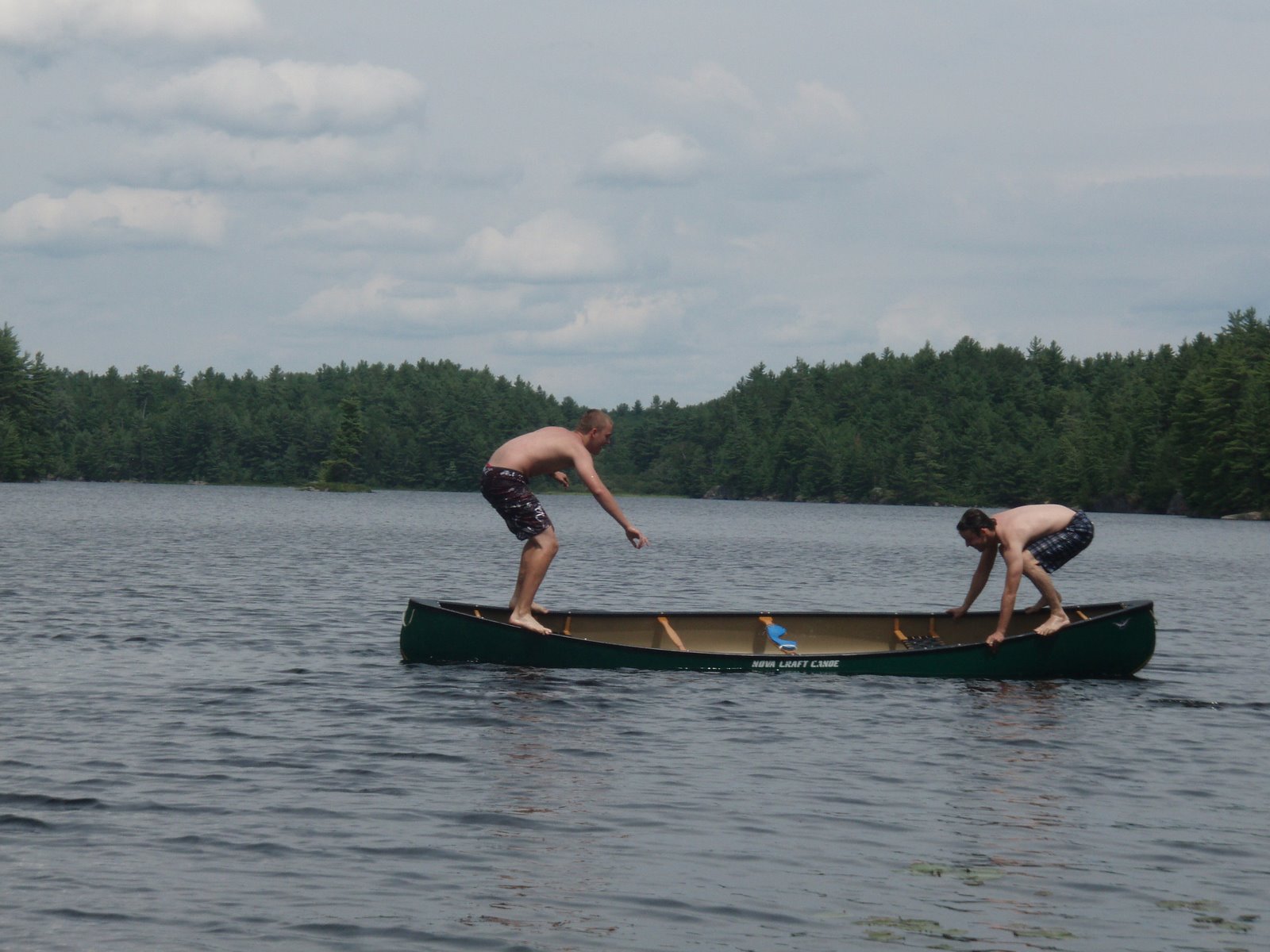
    On the first day at the camp site my little brother, Robert, and I decided to have some fun with gunwhale  bobbing. I won. But not without a price. Here’s the order of events:

    We get into our positions and start bobbing.

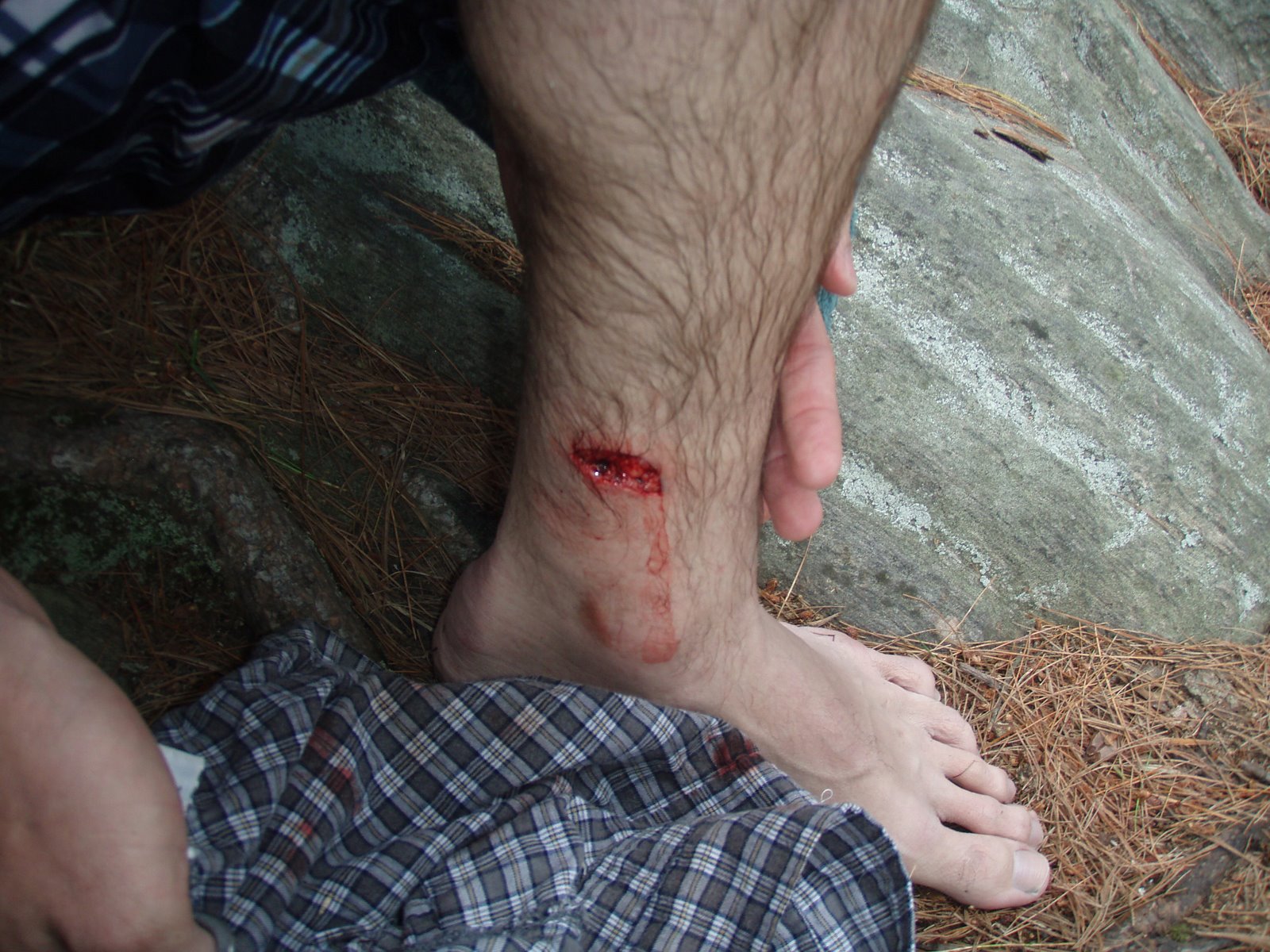
    I manage to cause Rob to fall into the drink.  I lose my own balance right afterward and fall in, hitting my leg on the gunnel as I go.

    Feeling the pain build in my left left, I struggle to shore to examine the damage.

    Ow!

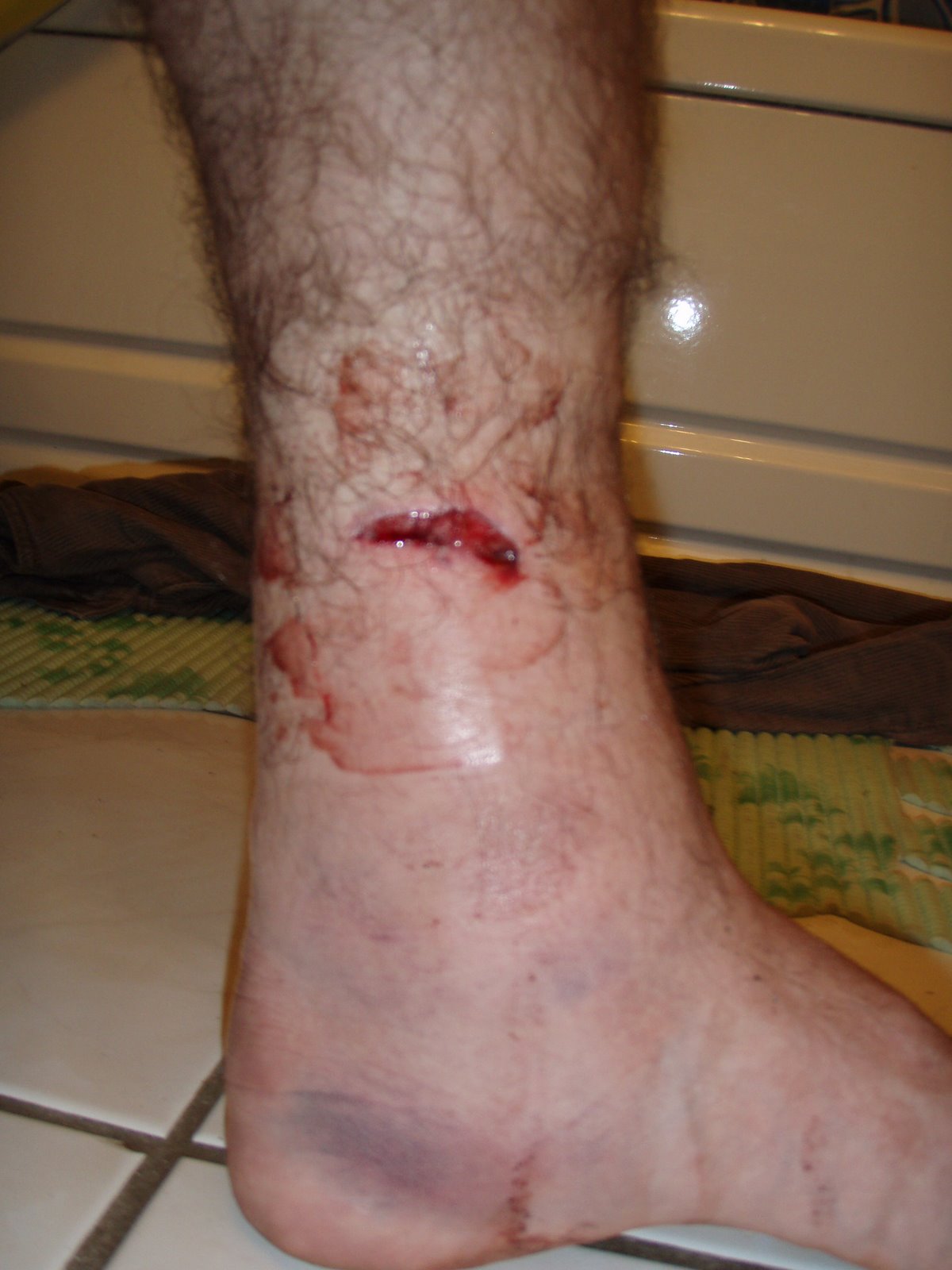
    It needed stitches, but this was the only trip where we didn’t bring needle and thread.  I tried to use fishing line and a saftey pin, but I couldn’t get the line to go through the holes I made.  I ended up just throwing a handful of bandages on it.  I expect a decent scar to show off.  Here’s a shot after we got home:Pretty, eh?
    So, yay for camping!  Here’s a video:

    var addthis_pub=”4a0af351783743a8″;
    Bookmark and Share

    This is second-hand unless you’re reading it at http://www.theilliteratescribe.com

    Up @ Night #8 – Mortality

    Have you ever thought about mortality? That’ll keep you up at night, even if nothing else will. Doesn’t matter much if you’re thinking about your own mortality or someone else’s. Mortality is a sleep-killer.

    The death of my father-in-law really brought the truths of mortality home to me. It became something real, not just the general, yeah-i-know-i’m-gonna-die feeling. More of a substantial truth, death-is-coming-for-us-all feeling.

    Death is coming. One day, this body-machine of mine is going to stop working and my spirit will be violently ripped from it. It’ll probably hurt, too. And before that more and more of the people I love are going to slip away. One shot is all we got. One roll of the die. One chance at the wheel. One pitch at the plate. Once. It’s not like a video game, where, if you fail, you can always start over or try a different route. There’s no edit-undo button.

    Jonathan Edwards tried to think about his own death a lot. I thought that was a bit creepy. I bet that practice kept him up at night a lot. And I bet it made him a lot more careful in how he lived. No screwing around with this game.

    Mortality keeps me up at night. I get scared. Scared of dying. Scared of the people I love dying. And, most of all, scared of dying without having done what I ought to have done. Up all night long…

    var addthis_pub=”4a0af351783743a8″;
    Bookmark and Share

    This is second-hand unless you’re reading it at http://www.theilliteratescribe.com

    Ariel’s Story #3 – Domos and her daughters

       Even though my stomach churned I couldn’t pull my eyes away as the grubby, fat girl continued to spew the contents of her stomach over the table. She seemed to have an unnatural amount of vomit available. Every piece of food was tainted by the time she finished.
       With a harsh choking sound she took her soiled hand from her mouth, brushed her hair back and rubbed the tears from her eyes. She stared at the crowd, winked, farted and walked away, laughing.
       “Well,” I said to myself, “you don’t see something like that everyday.”
       “No,” said the man beside me. “But most days.”
       “Does she never share with the crowd?”
       “Never. Sometimes she calls young girls to come in and become her daughters. But they are never seen again.” He looked down to the ground, kicked at a stone, put his hands in his pockets and slowly turned to walk away. The others in the crowd followed suit.
       The sky darkened. Thunder crashed. Lightning followed after. It rained.
       The downpour was torrential. It made me think of gaudy words that always look ugly on a page or screen like copious, plenteous and superabundant. I was soaked to the bone in seconds.
       Lightening and thunder flashed together. I was about to run to shelter when I caught a glimpse of the lobby doors. The girl, Domos, was standing there, waving to me. Beckoning me to come in, out of the rain.
       I struggled past the razor-wire fence, slicing my leg a little, and came to her door. It was locked. The rain fell painfully hard.
       “You wanna come in?” Domos yelled, pressing her oily face against the glass. She grinned wildly, exposing sharp, elongated eyeteeth. “It’s raining. You might get wet.”
       “Yes, I suppose I might.” I was shivering. “I’d love to come in, if I may.”
       “And if you may not?”
       “Pardon?”
       “If you may not. Would you still want to come in if you may not?”
       I blinked. “I’m not sure I understand.”
       She glared at me. Smiled. Frowned. Rubbed her face on the door, making a hefty streak. “Screw off.” She turned her back to me, tried to jump and click her heels and sauntered off.
       I walked from the door, knowing that no amount of running would make me any drier, and began searching for a dry place to stay.
       Night seemed to fall.

       The three figures in black cared little for the rain. It beaded and slid off their oiled jerkins, hoods and bare arms. Crouched beneath the shrub by the door they waited and watched. Silent. Angry. Armed.
    The Stranger and Domos talked very briefly at the door. Domos, in her characteristic way, had enticed him and told him to push off. He wandered in the rain now. Domos was inside. Safe, she thought.
    Without sound or signal the three moved in unison to the door. The leader took a vial with a dropper out of a pouch at his belt. He squeezed the liquid into the door-lock. A silent hiss and puff of smoke and the door was unlocked. They went in, crouched, hands on hilts.
       Ignoring the elevator they sped to the right, down the hall through a door at the end and up the stairwell.
       There was no need to talk as they raced silently up the stairs. Their legs pumped like well-oiled pistons. Their eyes, under their hoods, blazed brightly, full of life. Their hands stayed at the ready. Merciless. Hard. Uncompromising.
       They reached the penthouse. Out of his pouch the leader took a tiny mirror. Placing it near the bottom of the door he peered into the room. Satisfied, he put his mirror away, pulled something small and round from his pouch and put his hand on the doorknob. The other assassins crouched at the ready. Hands firm on their hilts. Positioned to burst through the door as soon as it was open.
       With the kind of speed only a predator could possess he pushed the door open and flung the flame-pellet to the ground. With a violent flash and burst of sound it exploded, scattering flaming particles to every part of the room.
       They worked fast.
       Domos was crouching over the corpse of a girl a little younger than herself, her teeth embedded in her throat. She didn’t even have time to turn before a blade removed her head from her body.
       Particles of flame began to settle and land, igniting the room.
       Bodies upon bodies were strewn around. The daughters of Domos. None decomposing. Quickly the assassins went to each and decapitated them.
       The flames crawled and began to lick at the stone walls, setting even them ablaze.
       Though there were hundreds of bodies the assassins worked fast. As the fire became an inferno they finished and sped out the door they can come in and down the stairs. Everything in the penthouse was reduced to ash and salt.

       The rain had already stopped when I noticed the fire. Like a lighthouse beacon it blazed in the clear night, sending heat from the very top of the building down to where I was standing. A crowd gathered around Domos’ building. Three men in black jerkins stood just outside the door. One was setting a sign up in front of the door. Another was clearing away the razor wire. I read the sign:

    Behold, this was the guilt of Domos: She and her daughters had pride, excess of food, and prosperous ease, but did not aid the poor and needy. So I removed them. For further details see paragraph 8 of section 16 of article 26 in the Code. Peace be upon you all.

    The fire burned through the entire night. Its smoke never did cease.

    var addthis_pub=”4a0af351783743a8″;
    Bookmark and Share

    This is second-hand unless you’re reading it at http://www.theilliteratescribe.com

    Discipline, Freedom and Paying the Price

    While at KLBC I read a book by Don Whitney. The premise was simple: Discipline is the price of freedom.

    Of course, I had to agree right away. The amazing guitarist paid for the freedom to make his music with discipline. The Olympic athlete paid for his abilities through discipline. The software developer, doctor, dancer, singer and painter all paid with the currency of time, sweat and discipline.

    But I never really made the connection with writing.

    I love fiction. Reading and writing it. But it seemed that the ability to write decent fiction came in spurts. One day I could belt out a couple thousand words of good stuff. The next week I couldn’t write a thing. Non-fiction was always easier, because it’s a lot like talking (which I’m very good at). But fiction came and went. for a long time I assumed that this was just the way it goes.

    But it’s not, really. There is nothing fundamentally different between fiction writing and music, visual arts or athletics. Some people have natural ability, yes. But everyone who wants to excel needs to pay for it.

    But I never made that connection. And it stunted my writing. While other aspiring writers are busy with writing exercises and other talent-building strategies, I only focused on projects that seemed ‘productive.’ Just the things that seemed to have a use in themselves. I think I ripped myself off. The Olympian doesn’t feel like he’s wasting his time by running even though there is no race. The informal running prepares him for the race.

    So I’m going to run more often (metaphorically, of course). A lot of my writing may never be read by anyone. But that’s okay because whatever I write will support and build and solidify the things that will be read.

    On we go!

    var addthis_pub=”4a0af351783743a8″;
    Bookmark and Share

    This is second-hand unless you’re reading it at http://www.theilliteratescribe.com