Matt W Cook

writer.former fundamentalist.christianly fellow

Morning Devos: Job 27:5

Job’s friends are still at it. He says, “God forbid that I should justify you: till I die I will not remove mine integrity from me.”

There’s something noble about being willing to face death before disintegrity. I think integrity isn’t the same as convictions. Integrity implies a kind of stable wholeness. It implies my integrals–my important things–are in position and cared for.

Job can’t repent for something he hasn’t done. He’s not going to capitulate to his friends on their word, because that would ignore what he knows about his situation and experience. In the end, his friends can’t understand, but that doesn’t make it Job’s job to justify them. He just needs to hold on to his integrity.

Morning Devos: Job 21:3

Job’s friends were downers. I guess they probably had good intentions when they first came, but Job’s condition was so mind-reelingly bad that they sat there speechless for three days trying to figure it all out and came to the conclusion that Job must have sinned because there’s no way a just God could let an innocent man suffer this much.

Job’s all, “No I’m a good guy, this isn’t fair, something’s wrong,” but his friends are like, “That’s not possible, Job, it’s a more or less just world and we more or less know the rules to it and the rules say you must be in the wrong somewhere. In fact, your attitude is downright disrespectful and basically proves you’re in the wrong.”

It’s been going on more or less like this since chapter three. Whatever the conclusion ends up being, the striking thing about the conversation is that everyone knows the answer to Job’s problem, even though they haven’t heard anything he’s said. By chapter 21, Job’s caught on.

“Suffer me that I may speak,” he says. “And after that I have spoken, mock on.”

Christianly Book Review #1: The Life-Changing Magic of Tidying Up

Marie Kondo’s “the life-changing magic of tidying up” is not a Christian book. It has nothing to do with Christianity. I didn’t even finish it. Nevertheless, it seems an ideal first book for the year of living christianly because it’s the first book I read this year. If I dig hard enough I can find parallels, I bet.

First, Marie Kondo promises big stuff. She claims if you do it her way, your house will never get cluttered again. Crazy, right? In a completely different way, Christianity offers to change your life forever.

Second, the KonMari is really simple. “Start by discarding. Then organize your space, thoroughly, completely, in one go.” That’s on page one. You could stop reading and just do it now.

Third, the KonMari is surprisingly difficult. You have to go through every single possession, category by category, physically handling each, and keep only the things that spark joy. Seems risky. This is where most people stop. Just like rigorous Christianity!

Fourth, something about the KonMari seems to really work. We KonMari’ed our house during Christmas break and there hasn’t been any return to clutter since. In the same way, we’ve all heard stories of people whose faith overcome real-life problems.

Fifth, I only had to read half the book to get benefit. I read the whole thing and learned the KonMari fold (it looks really cool) I’d have even more KonMari magic. Even so, the amount of KonMari I was able to put into my life was enough to make positive change.

Sixth, the KonMari changes how you look at things. We had twenty garbage bags and three van-loads of clothing, toys, electronics, books, gear, trinkets, utensils, dishes, furniture, and et ceteras that we are better off without. It’s not that we don’t need it—we don’t even want it!

Seventh, the KonMari makes it so you are only surrounded by the things you love. This parallel is a little reachy, so I’ll unpack it. While the KonMari offers freedom by removing unloved things, Christianity teaches indiscriminate love. In both cases, everywhere you look you see the Beloved.

Eighth, the KonMari can seem unpalatable, scary, against common sense, and is rarely seen through to its core. Similarly, the really powerful and difficult things at Christianity’s root tend to be left undone. G.K. Chesterton had a point when he said, “The Christian ideal has not been tried and found wanting. It has been found difficult; and left untried.”

All in all, I recommend the KonMari because it worked for me. It was a great way to clean house in preparation for my year of living christianly. If you have the time and will-power, get a copy, read half of it, and lay siege to your fortress.

The next christianly book review will be significantly more christianly.
What it Would Take to Believe

There’s beauty in the idea that we are chosen, and our reward will be worth any amount of suffering. There’s power in the idea that the Omnipotence indwells a believer. It’s great to believe that no matter how bad things get, the One in control of the cosmos has my back.

I’d wager it sounds trite to most unbelievers. The power of Evangelicalism is a bit like the harm of cultural appropriation: you can’t understand it unless you know the whole story. And even then there’s something important lost in translation.

See, every human restlessness and ache and shame and attachment is because of innate brokenness. Our souls are bent before birth, and our bodies reflect it. Ours is a world of exiles, so far from God that we wouldn’t believe the truth even if it slapped us in the face and sent us all to hell. Cut off from reason, we suffer and cause others to suffer until we die and reap suffering’s fulfillment.

Some are saved when God breathes life into their dead spirit, rips the scales from their eyes, gives them a heart of flesh instead of the stone inside. These ones are set apart. No matter what suffering they go through it will not be comparing the eternal weight of glory prepared for them through Christ.

I used to believe all that.

The year of living christianly is not about trying to recapture that belief–it seems dishonest to set out trying to attain any specific belief. But the other day someone asked me what I wanted from God. What would God have to do to prove that he was real? Well, faith is a gift of God, lest anyone boast. If God wanted to prove himself real to me, he would have to give me faith.

so either you aren’t real

or I am just not chosen

maybe I’ll never know

either way my heart is broken

– Derek Webb, “Goodbye, for now”

Morning Devotions

The main thing that bugged me about the State of the Union was the way Trump wove Christian narratives in his speech to co-opt religion into his uncompassionate policies. Even when I was a Believer I squirmed when politics stuck its greasy fingers into Faith. Faith almost never comes away clean when she screws around with politics.

So I’m going to talk about daily devotions this morning instead.

I get up around six. It’s dark and cold and I have to push away immediate feelings of hatred for all life. I don’t feel like a morning person during the first few minutes of consciousness.

I splash water on my hands and face. It’s cold because I won’t wait for the tap to warm up. The bathroom light is blinding that early. But now I am waking up.

I’m a morning person by the time I sit at my desk. I start with prayer.

I address my prayers to God—turns out I can still do that, even though I don’t think he’s real. I express my gratitude at the good things in my life. As I express, I recognize more and more good that I would not have noticed without a morning habit. Then I look to my struggles. Where do I want work/development/growth/sanctification? I close my prayers with a quiet spirit of willingness. I want wisdom. I am willing to listen.

In this spirit, I read.

Usually I read the Bible. I’ve read it cover-to-cover a few times, and I’ll do it again this year. I read slowly, with a journal and pen beside me. I read like a man looking for treasure in his basement. I almost always walk away with something, which is more than I can say about listening to the State of the Union.

Introducing a Year of Living Christianly

A boy walks through dark woods on a clear path he knows will lead to a celestial city until one day he emerges at an open field and the path is gone and he stands there saying, Well now what am I supposed to do?

I lost faith five years ago. Christ was all-in-all, so it meant losing identity, community, and my life’s purpose. It’s been a rough go, learning to live without faith. I’m starting to get the hang of it.

But I think about the Pilgrim’s Path all the time. I remember it being beautiful, for the most part, and worthwhile. So I’ve decided to go back for a visit. To get a torch and bag and walk the walk a bit. I don’t believe in God, so I can’t actually be a Christian, but I can do a year of living christianly.

In fact, I started last month.

Question: What is a year of living christianly?
A year of living christianly will be marked by these three facets: christianly ethics, christianly habits, and christianly stories. At all events, this means daily prayer and devotional reading, regular church attendance, and an attempt as sermon-on-the-mount styled love. I’m sure it will mean more, but this is the start.

Question: Why are you doing this?
First, to walk the Path again, for its own sake, to see what was lovely about it.
Also, to recapture some of the disciplinary power that the Christian walk seems to give. These years I’ve resonated with Bree the horse who lost the ability to push himself after he found freedom.
Finally, to open conversation about faith, its loss and change, and the stuff that comes after.

Question: Besides reading and prayer and going to church, what will you be doing?
Sharing. In a lot of ways I feel like I’ve been hiding from the world for five years. I plan to write about my experiences and invite conversations and review books. I plan to do things I haven’t thought of yet. Maybe you have a great idea for me.

Question: There’s a zillion kinds of Christianity, which one is informing the year of living christianly?
Evangelicalism forms the foundation I interpret Christianity through. That being said, I am interested in what other traditions have to say. That being said, I reserve the final judgement of whether an ethic, habit or story is christianly for myself. Kinda like every other pilgrim.

Question: Are you making fun of Christianity?
No, I’m being earnest.

Question: I have a book you should read for this!
Great! Tell me about it and I may add it to my growing reading list.

Question: Why don’t you just keep it simple and be a Christian again?
Because I do not think a personal Fathergod exists, and to pretend I do would be an insult to reason and religion. For this reason I also won’t be taking part in any sacraments like the Lord’s Supper.

Question: I have a question!
Ask! Comment or Facebook or Twitter or email or smoke signal. Let’s talk.

Gods and Dogs: A Review of André Alexis’s Fifteen Dogs

I tend to start my judgment of a book on two points: how long it takes to finish reading, and the opening line. I read all 171 pages of Fifteen Dogs in two days, and its opening line is great: “One evening in Toronto, the gods Apollo and Hermes were at the Wheat Sheaf Tavern.” A crisp sentence that puts two of our favourite gods in Toronto’s oldest tavern sets the stage for an engrossing modern myth.

Apollo and Hermes have a friendly argument about whether or not humans are very special, as far as mortals go. Hermes thinks we are. Apollo not so much. In the course of the evening, after five Sleemans each, they make a bet.

Apollo wagers “that animals–any animal you chose–would be even more unhappy than humans are, if they had human intelligence.” Hermes takes the bet, “on condition that if, at the end of its life, even one of the creatures is happy, I win.” On the way home, walking down King Street, they pass a veterinarian clinic. The fifteen dogs staying overnight receive human intelligence, and quickly figure out how to open their cages and escape.

The story is enticing. Each of the fifteen dogs has to negotiate their relationship with the sudden intelligence they have been given. Like the classic myths, Fifteen Dogs can be dark and violent. For this reason I wouldn’t recommend the book to dog lovers per se. It’s an apologue (a moral fable with an animal cast), not one of those tender tales of human-animal bonding. Fifteen Dogs is probably best suited to people interested in Toronto, classical mythology, and those nagging existential questions of humanity.

Like any good fantasy novel, there are maps in the beginning. The setting is integral. The dogs leave the vet’s clinic as if through a portal and the Toronto they emerge into is charged with the fantastic. My apartment is just a couple blocks from High Park, where much of the story takes place. Walks downs Roncesvalles and along the beach will be different, having gotten a dog’s-eye view of it. Or rather, a dog’s-nose view, because some of the most evocative moments are olfactory scenes of the beach in summer and the park in spring. If you’re from Toronto, Fifteen Dogs might enrich your city. I mean, who wouldn’t want a drink where Hermes and Apollo frequent?

The gods are Greek, thus capricious, unpredictable, and often distant. They aren’t in the business of making everything alright in the end and don’t have a habit of saving people. The gods in Fifteen Dogs are the same ones who pestered Odysseus and brought down Troy. The novel may not be The Iliad, but it fits nicely in the lineage.

Some books tell a good story, some explore big ideas. Fifteen Dogs manages both. Despite the initiating wager, the real interest of the book is not the pros and cons of human intelligence. “Really, it was a matter of pure chance who died happy and who did not. Which is why, of course, [Apollo] and Hermes had bet on the outcome in the first place.” The bet sets up a more subtle philosophical discussion. Now, if you don’t care for philosophical discussion, don’t let that push you off. The story stands on its own and the philosophy doesn’t get in the way. But if you’re up for it, the dogs have to deal with questions like:

  • What happens when you recognize the cruelty in the activities you love?
  • What happens when you realize something you love cannot last?
  • What happens when you recognize the gulf between yours ideas and your actions?
  • What happens when you chance so much you can’t remember who the real you is?
  • And on it goes.

In short, Fifteen Dogs is about fifteen dogs who become humanly reasonable one night, and they handle it just as well and poorly as the rest of us do. But since they’re dogs and live in a very realistic Toronto, we are able to see the humanity in them a little clearer than we tend to see it in ourselves. The book grabbed my attention from the very beginning, and it held on until the end like I was a chew toy. It explores deep human truths without getting preachy and brings an authentic sense of Greek myth into a very local-feeling Toronto. I heartily recommend it to anyone who didn’t cry during Marley & Me.

Saint Matthew’s Angel

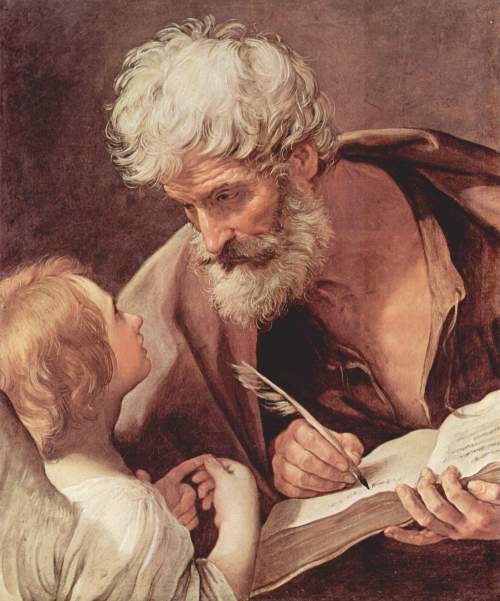
I found a great painting at a thrift store the other day. An older-looking man is giving rapt attention to an angel, who tells a story and plays with their fingers. You can picture the child-like voice saying, “And then… and then…” It’s called Saint Matthew, and the Angel, by Guido Reni.


guido_reni_043


There are other paintings of Matthew with his muse. This one’s by Caravaggio. He has the angel sensually guiding Matt’s hand to write something that, judging by his raised brow and tight grip on the book, blows his freaking mind.

www.mikeyangels.co.uk


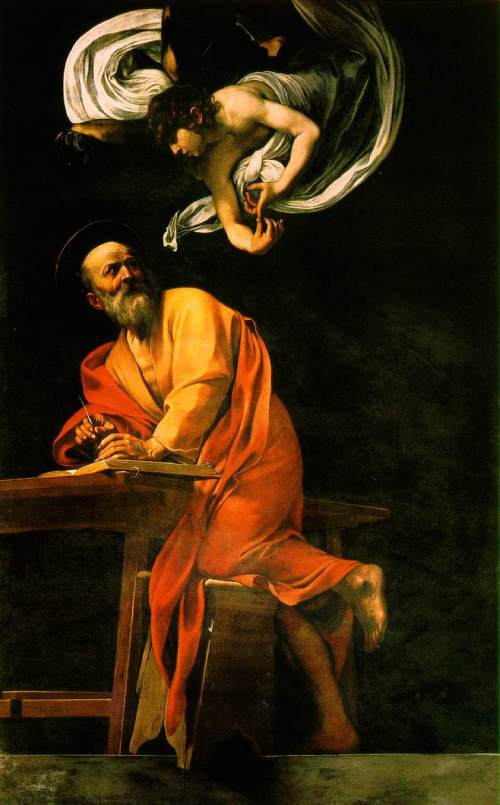
Another by Caravaggio has Matt presumably driven to the writing desk in the middle of the night. He looks more than a little freaked out, balancing on the stool and trying to write whatever the angel is counting off.

the_inspiration_of_saint_matthew_by_caravaggio


Rembrandt did one, too. His Matthew is solemn, and his hand hovers under his chin as if he completed a beard stroke. The angel whispers from behind now. There’s less urgency than in the others, but more depth.

rembrandt_harmensz-_van_rijn_049

I don’t know much about the inner workings of creativity, but I’ve always loved the idea of a supernatural muse, some capricious but lovely whisperer that helps me write my things.

Who tells a simple child-like story that can pull the cynicism out of an old man’s eyes.

Who tells a tender truth easily pointed out that paralyzes us with wonder even as we try to write it.

Who pulls us from bed sometimes with something that will be lost if not recorded now, at this moment, in this spirit.

And who sometimes quietly, from behind, speaks with a depth that gives great pause.


Monday of all the plans

It’s Monday and I have a couple options. The first is the Garfield plan. This is when I stare at the ceiling, curse the day and the days that will follow, and grumble from one bit of forced labour to the next.

Or I could play along with Monday and its list of things to do. Fine, Monday, what do we have this week?

  • Prepare a presentation on Augustine and Caesarius of Arles due Thursday.
  • Write up a plan of study for the master’s programs I’m applying for.
  • Revise a chapter or two from the 12-years-and-counting fantasy novel which will either kill me or make me rich and famous.
  • Revise the short stories that will be sent into contests and other applicatory things.
  • Read all the books and all the articles.

There’s more. I’m sure of it. But I won’t get to see them unless these get cleared up a bit. What are you doing this week?

Ruth! It’s your birthday!

I married you when you were 23. At this point we’ve been together for about a third of our lives. That’s kinda wild.

Do you remember when we were first married and people were telling us about how much it was going to suck? Someone, I don’t remember who, said just watch out, because people change. I was scared, I’ll admit. I was rather pleased with the wife I’d found and didn’t like the idea of you changing.

But here’s what people didn’t tell me: Change is good. Our life together has changed the both of us, not just every birthday but every day, every conversation. And I love the ways that you have changed. I love the people you have been over these crazy thirteen years. I am full of excitement thinking about the changes we’ll experience over the next thirteen years and the thirteen years after that.

All this is to say, Happy Birthday, Ruth. I love you more than you know, and I love everything you’ve become and everything you’ll be.

See you tonight.

x