Matt W Cook

writer.former fundamentalist.christianly fellow

Winter Morning

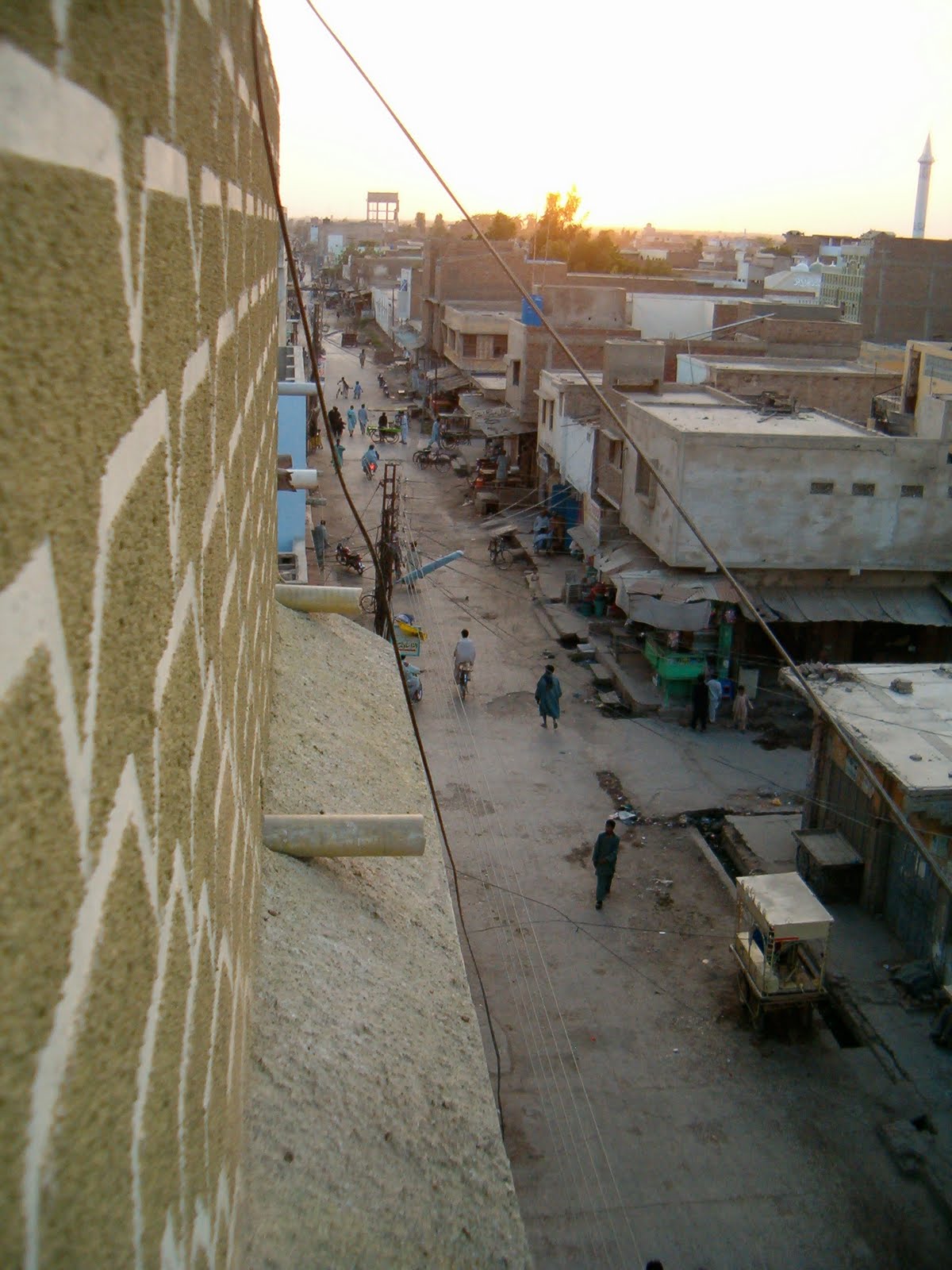
Morning in KunriIt’s hard to get out of bed in the winter in Kunri.  My Canadian friends laugh at that.  But in Canada we live in heated houses with thick insulated walls.  In Kunri we live in airy cement blocks.  It’s not the force of the cold, it’s how we are set up to deal with it.  We put on our sandals before pushing open the bedroom doors.  Feet go quickly numb in the winter.  And once they’re numb it’s hard to get them feeling right again.  Short of a hot shower.  But those are hard to come by in Kunri.

Fajr

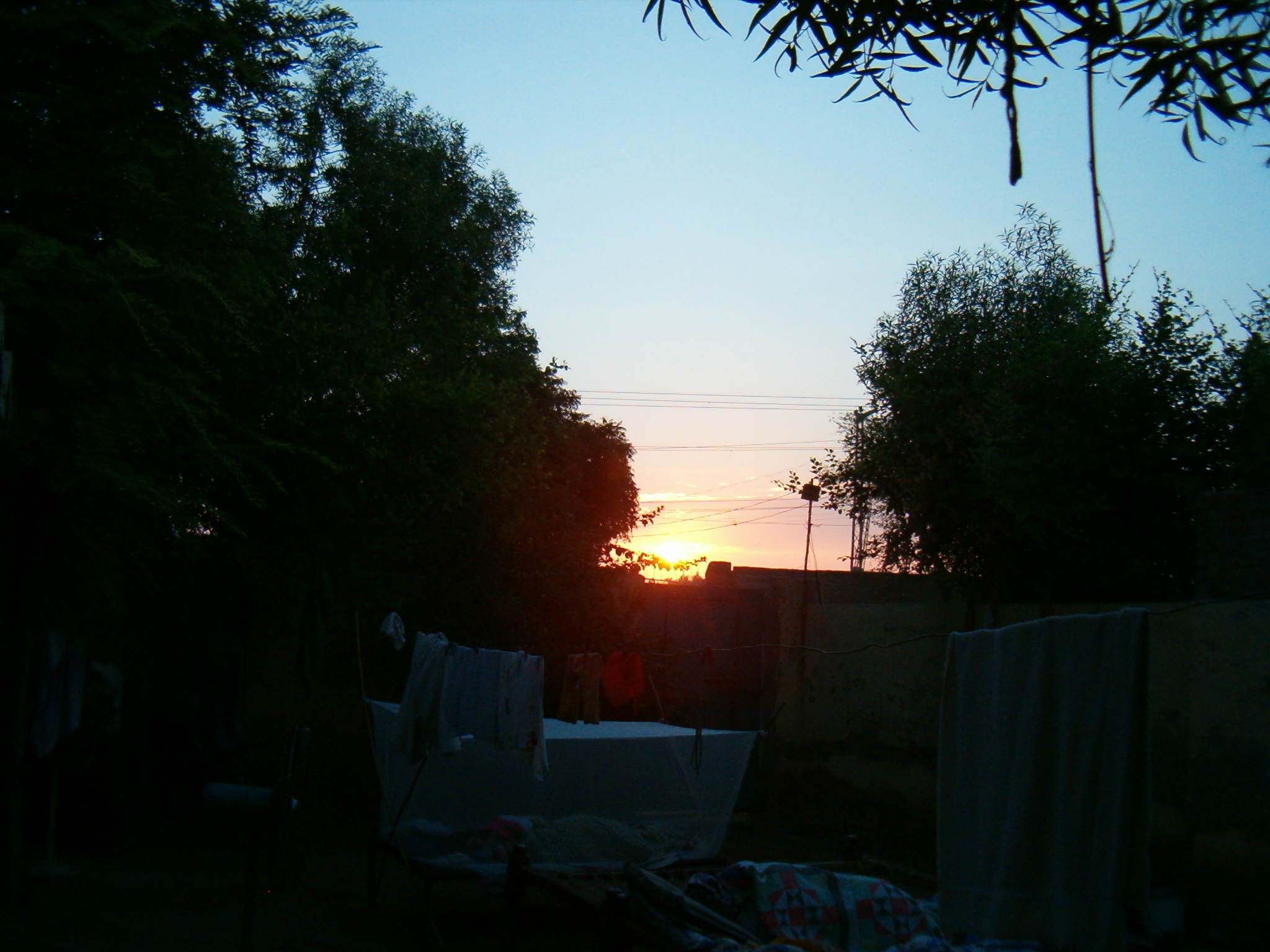
MorningFajr wakes us up while it’s still dark.  We groan a bit to each other and thank God that our religion isn’t so loud so early.  But we don’t really begrudge it, I think.  The quiet minutes after Fajr, before we slip back into sleep, are wonderful.  Especially in the winter when we have heavy blankets to huddle inside while we listen to morning birds in utter darkness.  And especially in the summer when we sleep in the courtyard with nothing between us and the sky but a thin mosquito net and a sensually warm breeze.  Especially anytime, I guess.

The Great Collaboration

There is an invisible collaboration between the artist and the consumer. The band does not make the music. Your mind does. They encode their message in vibrations in the air, markings on a page. You decipher them.

I once asked a painter about the meaning of one of her paintings. She asked me what it meant to me. Because the making of the work—the coding of an experience onto a medium—is only half the art. The rest lies in the power of the beholder.  If a tree falls in the forest and no one hears it, it doesn’t make a sound.  Sure, it vibrates the air, but with an ear to sense the vibrations and a brain to convert them into noise, there is no sound.

In a real way, by hearing and seeing and touching, you are calling art and creation into existence.

Writing Mantras #1

I love mantras.  Not (just) those ancient words and sounds used in meditation, but the slogans or sayings that remind me of important things.  I used to paste them up on my wall at college in a valiant effort to get out of bed early and win life.  They’re handy little ways of fighting resistance and keeping myself on the path I want to walk.  Here’s an awesome writing mantra for you:

One step at a time.

Pretty simple, eh?  You’d be tempted to throw it out because it’s so simple and boring.  Heck, it’s so boring that you can’t even cite who said it first.  Everyone says it.  But it’s one of few concepts that has truly had a measurable impact on my writing, my family, and my life in general.

I’ve got a great imagination, and that lets me feel how huge a huge project is.  So when I sit down to write a 180,000 word novel, I can feel the weight of its impossibility.  And then I think about the necessary sequel.  And what after that?  Holy crap what am I doing?  This is too big!  I’m not up to this at all!

But a little work every day gets the work done.  One scene at a time.  One step forward every day.  I don’t need to feel 180,000 words on my back.  I’ll deal with 500 at a time.  At 500 words a way, the novel is finished in a year.  It works with pretty much everything, too.  I don’t think about raising my kids to be heros, I think about playing with them and being their hero today.  I don’t think about publishing and getting rich and famous, I think about getting this one scene done tonight.

One step at a time.  The best part is, it’s the only way to do anything anyway.

My Toronto Flood Story

The subway only took me as far as Jane, where shuttle buses had been called to stand in for the flooded underground. There were hundreds of us spilling onto the street, trying to see over each other’s umbrellas to glimpse any coming buses. The rain was not cold, so it didn’t bother me that I seemed to be the only one without an umbrella. It was a very Canadian moment, because we all seemed to be in reasonably good moods, considering. I smiled when I looked up at the dark sky. A woman made a joke as an empty bus drove by. Laughter rippled across the crowd.

Source: huffingtonpost.ca

Source: huffingtonpost.ca

Our shuttle arrived and we pushed our way on it with surprising gentleness. We weren’t a mob trying to get that last seat. We were a crowd banding together to weather a storm. And there’s something wonderfully fun about banding together with strangers.

The bus sped down dark streets that were usually alive with noisy lights. We pressed tightly against each other, forgetting how awkward it is to be around strangers. It was one of those rare moments where Toronto and rural Pakistan meet. The crowded bus. The dark city. The tightly-packed strangers. The absence of anxiety. When we had to detour because of flooded underpasses, we joked about it. When the bus began to stall and the lights flickered, we trusted our driver who told us that she would get us to Kipling, come hell or high water.

She got us through the high water. But we didn’t come up against hell until we arrived at Kipling Station.

Many of us needed to transfer to the 45. It pulled into the station just as we arrived. The crowd clustered around it had little of the positive energy the shuttle had. Even as the doors were opening to empty to bus for us, people were yelling and swearing at each other. There were threats of violence as people shoved each other out of the way to cram onto the bus. Being swift of foot and small of frame, I was one of the lucky ones who made it.

The ride was angry and long. The people were angry because the bus driver was late in returning to his seat. The bus driver was angry because people would not keep behind the white line.

“I’ve been waiting four hours!”

“I’ve been working six!”

Emotions escalated until the driver threatened to pull over and kick us off. That shut the noise off, but did nothing for the atmosphere. It was a different feeling as we crawled up the dark streets that time. We weren’t a community struggling against a storm. We were strangers fighting for limited space.

The mind is its own place and in itself, can make a Heaven of Hell, a Hell of Heaven.
– John Milton
Gulping Life

I go to bed with a shot of Dr. Mcgillicuddy’s Peach Schnapps. Ever tried it? I don’t know much about liquor, but I know I like it. It’s smooth and bursting with sharp peachy juiciness. It’s always a little sad when the glass is empty.

I tried making it last longer the other day. Instead of taking my shot and letting it go its merry way down my gullet, I held it in my mouth to prolong the pleasure. It didn’t work, of course. It quickly turned harsh. It wasn’t a pleasure that was meant to be prolonged.

This is a picture of a cat.

This is a picture of a cat.

Do you remember how much you loved juice (and life) as a kid? There is no passion in the world greater than a child’s passion for juice (and life). Juice (and life) gave you an exhilaration that made you believe everything was right with the universe. And when you got your tiny hands on that massive glass of deep purple, you gulped it as fast as you could, relishing the holistic sensation as the precious liquid rolled down your throat. But, inevitably, someone much taller than you would come by, notice all that fun you were having, and tell you to knock it off.

“Slow down and enjoy it!” they would tell you, as if you weren’t already in the raptures of juicy bliss. “You can’t even taste it!”

Of course I can taste it! But taste isn’t even the foundation of the joy of juice (or life). It’s the wild abandon of gulping. It’s the excitement of consumption. There is a hidden passion in the purple stuff. But adults don’t get that. They forgot that juice (and life) is meant to be gulped.

And when you forget a pleasure, the most annoying thing is to watch someone else remembering it. That’s why kids aren’t allowed to gulp. That’s why kids aren’t allowed to sing in public or be loud or laugh at crude jokes. Not appropriate. Bad deportment. Get in line, wipe that grin off your face and be serious, because somehow seriousness is better than levity.

Let us roll all our strength, and all
Our sweetness, up into one ball;
And tear our pleasures with rough strife
Thorough the iron gates of life.
Thus, though we cannot make our sun
Stand still, yet we will make him run.

– Andrew Marvell, To His Coy Mistress

Bollywood Hits – Baazigar O Baazigar

Ever watched something so awkward that you had to turn away? I love Bollywood, but the title song from Abbas-Mustan’s 1993 hit, Baazigar (Gambler), nearly broke me.

As over-the-top-ridiculous as this song is, the film itself is a serious thriller that shook Bollywood with its dark anti-hero. It was a box-office hit and Shahrukh Khan’s breakthrough role.

Go figure.

Love on the TTC

I sat under the brightly-lit overhang at Kipling Station, waiting for the 45 to take me to work.  The night was bright and living, a perfect urban evening.  A girl sat on the bench next to me, hugging her knees and hiding her face.  A boy sat on the bench next to her, trying very hard to look the other way.  When the 45 came, he mumbled something to her and walked off.  She dried her eyes and followed him.  I followed them both onto the bus.  They sat together and I sat across from them and pretended to read.

They were angry at each other.  Or sad at each other.  Or just tired.  They were probably going to spend the whole trip sad at each other.

TTC

But then one of them spoke to the other.  And the other said something back.  And they were talking.  I couldn’t understand what they were saying, but I could feel it.  I could feel the sadness in the girl’s voice and its mirror in the boy’s.  The girl fidgeted with the boy’s backpack while she talked.  The boy started to look at her face instead of the floor.  They sounded defensive.  They sounded accusatory.  But they kept talking anyway, even though it looked like the words were making them feel worse.

Then there was a sudden and startling change.

The girl threw her arms around him with a sudden sob.  The boy squeezed her tight and said something loud and affectionate.  Something that spoke of promise.  The girl laughed.  The boy kissed her on the mouth and she melted into it.  Others on the bus grew embarrassed.  I grinned at them.

Thank you, you delicious people who refuse to settle for sadness and broken relationships.  Thank you for sharing peace with each other in a public place so I could watch and remember that peace is out there for anyone who wants it.

And thanks for wanting it.

Into the Thar

I took a drive into the Thar.  The sun was hot and dry and beautiful.  Sand stretched around as far as our eyesight would carry us.  We stopped the car and got out in a place without any memorable landmark.  We walked around and looked at the nearly nothing that surrounded us.

Tree in the Thar

My son was two or three.  He was enthralled by the endlessness of it.  A place without walls or horns or people.  A place where you could run without watching and fear no accident.  No ditch to fall into.  No traffic to be wary of.  Endless surface just begging to be played with.

We crouched own on the ground together and looked at the sand.  It seemed like any other sand at any beach or children’s play pit.  We picked it up in our hands and let it slip through our fingers.  Eliot was able to see fear in a handful of dust.  We saw beauty in a handful of sand.

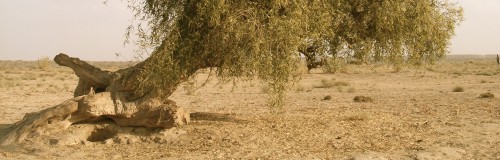
TharDespite its playful novelty, the desert was an obviously hard place.  Everything alive had to fight to keep living.  Every dry and thorny bush.  Every skittering lizard and scorpion.  And every tree. You wouldn’t think there would be trees in the desert–and deeper into the Thar there wouldn’t even be these grasses, let alone trees.  But here there were a few daredevil khejri and neems that had managed to beat the odds to stand alone in vast fields of sand and sparse grasses.

Night fell and we were still out in the open desert.  We wandered as the stars burned against the night sky.  There were no clouds or city lights to hide them.  I had seen stars before–I had been raised on constant trips into the Canadian wilderness.  But even the vibrant stars over Temagami could not compare to the lights above the stark emptiness of Thar.

We looked up at a menagerie of flame and void.  The Milky Way scattered itself across the scene.  One Pakistani folk tale says that the Milky Way is made by the spirits of dead youth who spend eternity scattering grains of salt across the sky.  I believed it that night.

We stayed for a long time, walking, praying.  The void of desert and sky brought out something within us we all had forgotten.  A certain mysticism that all religions try to stumble toward and none really manage to grasp.  A sense of the immensity, beauty, and absurdity of existence.  An understanding of the cosmic power of love.  A yearning to fly into the waiting arms of the universe herself.

Our Birth Story

When birthing our first and second children, Ruth coped through medical technology.  Both experiences were mostly negative, which I guess is what we were expecting anyway.  I mean, who sets out to try and enjoy labour?  Even the name we give it–labour–suggests that it’s not going to be a fun thing.

Three KidsSo for our third child, we wanted to try something different.  We got hooked up with the amazing wonderful people at Kensington Midwives.  Their care and nurturing concern for us and the nascent little human freed us to look at childbirth in a different way.  No as a medical condition to deal with, but as an act of creation to enjoy and experience.  So when the contractions started on Thursday, April 25, Ruth was excited to greet them with Zen-level mindfulness.

Ruth played with her contractions as they grew and spilled over onto Friday.  She would see each one coming and, instead of bracing against it, she would breathe and watch.  She would mentally acknowledge the contraction, thank it for preparing her body for birth, and gratefully send it on its way.  And it worked.  We spent the day doing all the same things she had been doing since before the pregnancy began—walking, jogging, taking the stairs, getting hot oil massages and having wild sex.  Pretty much normal life for us.

In the wee hours of the night, Ruth woke up.  The contractions had been steadily growing in intensity and consistency and had reached a point where Ruth was having some difficulty managing while in bed.  She woke her vigorous husband at 3:00am, who drew her a bath and vigorously went back to bed.  Ruth spent half an hour in the tub, rolling with the contractions as they went through her.  After a time she got out and started pacing the house, kneeling, squatting, going on all fours, searching for a position that would give her a bit of an edge as she dealt with the tension.  And even though she had to move around the house and use all of her mindfulness to get through them, they were bearable.  Not only that, it was enjoyable and she was glad to have the opportunity to face them alone.  She woke her husband at 4:20 and they called the midwife.  The time was close.

She almost called too late.  Our on-call midwife, Sara, was half an hour away.  Sara arranged for Houley, another wonderful midwife from Kensington Midwives, to come as well, because she was already in the area finishing up another birth.  Houley arrived just as Matt finished setting up the bed for birth.  She did all the lovely midwifery stuff that midwives do, and told Ruth that if she felt like pushing she might as well go ahead and do it.

Sara, our main midwife, arrived at 5:00am, jogging with her big backpack of midwife gear.

Isaiah Dev arrived at 5:08am.

Sara caught our son as he came out and handed him to Matt who rested the child on Ruth’s belly.  He was warm and slippery, covered with the broth he had been cooked in.  And that was it.  There he was.

Out other children were born in good, modern hospitals—the first in Canada, the second in Pakistan.  Both were very safe, highly professional places.  Sanitary, organized, business-like.  Both births were very much like watching a mechanic work on your car.  There was no magic, just mechanics.  We didn’t touch our children until they were appropriately cleaned and prepared.  And even then we had to give them back so they could endure some time under that blindingly warm light with that odd goo on their eyes.  The doctors who delivered our children disappeared immediately after it was over.  Sara stayed with us for hours.  The doctors told us what choices to make.  The midwives gave us information and asked us what choices we wanted to make.  In the hospitals Ruth was a patient with a condition to be cured.  With the midwives, she was a holy person creating another person.

Sara and Safire at Kensington Midwives completely blew our minds.  We never expected the level of care they gave us.  Because of them and all the other midwives and students and staff at Kensington Midwives, Ruth not only endured her pregnancy and labour, she enjoyed them.  Labour stopped being a painful thing to get through, it became a rare and vibrant experience to drink in.  It was not labour.  It was birth.

We learned things.

We learned that labour is not a trial to be endured—it is an experience to revel in.
We learned that your mindset will determine a large part of what your experience will be.
We learned that everything goes better with mindfulness and everything goes worse with worry.
We learned that Ruth is an awesome creator of humans and had no need to wake her husband or cry out for help when it was time to give birth. She is mighty enough to rely on her own strength.

That’s our story. We cannot thank the people at Kensington Midwives enough. Thank you for showing us how powerful a mother can be. Thank you for being a part of our person-making project.