Matt W Cook

writer.former fundamentalist.christianly fellow

Tag: jesus

I believe in God (an apology)

What is God?

It’s hard to believe in God today, especially if ‘God’ means a supremely good and powerful Person who made the universe and is very concerned with the beliefs and behaviour of mortals. The texts about this god often paint him as petty and contradict what we know about ourselves and the world. Also, this god’s representatives are often no better than the folks who ignore him.
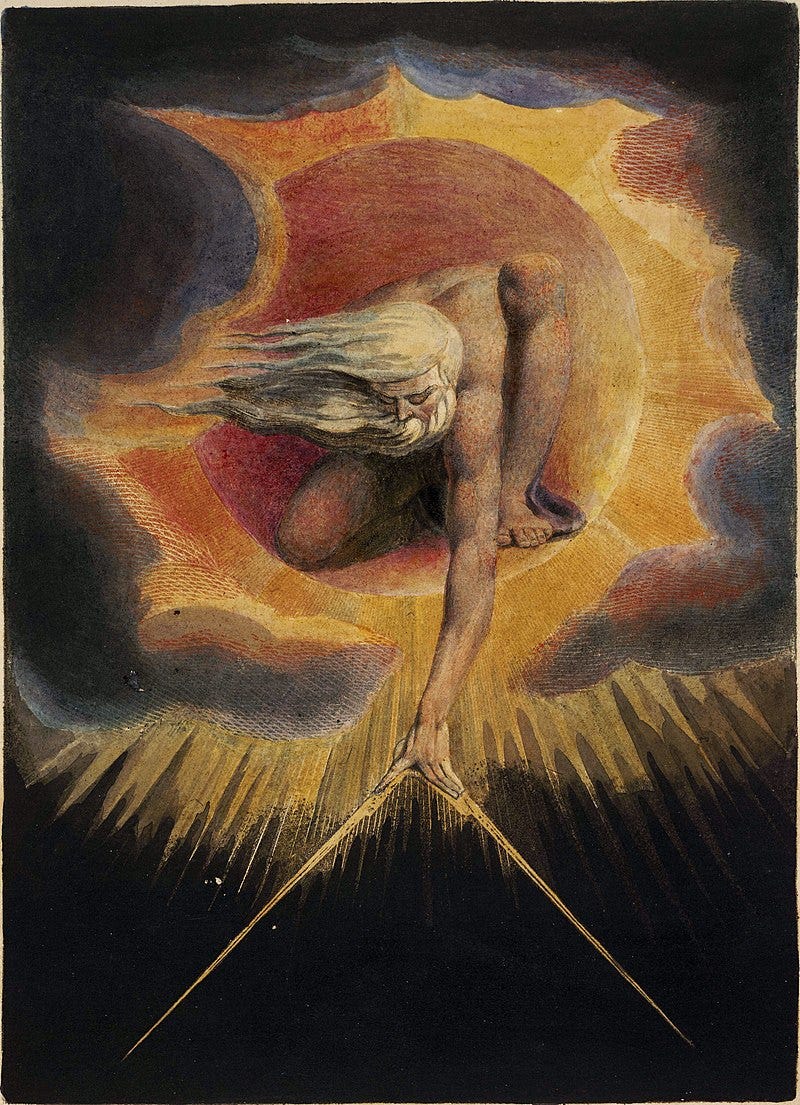
The Ancient of Days by William Blake
And it’s always a him.

If God is a craftsman, crafting a cosmos, then God must be less than Godself + God’s craft + the God-sized room within which God crafts, thus not God.

Here’s my take: God is the Infinite. The that-than-which-nothing-greater-can-be-conceived. The Alpha to Omega, A to Z, First and Last, the Beginning and the End.

God is before all things, and in God do all things consist. All things live and move and have their being in God. Everything that is, is in God, and there can be nothing outside of God. When I speak of God, I mean the single, infinite substance that constitutes the universe. If this sounds like Spinoza’s God, it more or less is.

Objections

But this God isn’t personal.

God is not a person, but that does not make God impersonal. God is not less than a person. God encompasses every past, present, and future person. So, insofar as God can be known, God can be known personally.

Because God is the sound of a tree falling in the forest; real when I hear it. God is personal when I engage in a personal relationship with God.

We make personal relationships with everything, even when we don’t mean to. When I trip on an uneven sidewalk, the stone is malicious. When I’m stuck on the highway, the traffic is evil. And this isn’t totally irrational. Consciousness must be as natural to the universe as magnetism or the strong and weak nuclear forces. Empathy (and anthropomorphism) is consciousness attempting to recognize itself. There is love here.

So, since I am a person, I crave a personal relationship with God. Religion is a way to intentionally, specifically, and skillfully cultivate a personal relationship with God. There are others.

This isn’t the God of the Bible.

The Bible does not present a unified depiction of God (thank God). Paul understands God differently than Jesus, who approaches God differently than Moses. Origen would not have agreed with Augustine who would not have agreed with Calvin or Darby or any Christian alive today. Every theologian has understood God differently, despite common heritages. This is not (necessarily) a problem.

The Bible is not a science text or a user’s manual. It is a library connecting today’s living faiths with their ancient roots, buried deep in inaccessible history. Its purpose is not to declare facts about God, but to show the depth of our inheritances and inspire us to grow forward from faith to faith, glory to glory, preparing the way for something amazing. To confess Christianity is to take our place in this ever-changing Body of faith and practice.

The Bible has its proper place in my faith: a Godsend, and useful for apologies, gospels, rebukes, and encouragements: so that the religious practitioner can be skilled and equipped for every good work.

Why Christianity?

It is my inheritance, and my children’s after me. Years of practice gave me a rather particular set of spiritual skills. Prayer still lets me talk to God, hear God, and reaffirm my best aspirations. Worship still fills me with joyful holy awe. Scripture still provides spiritual meat and drink. The Father still hides in unapproachable light. The Son is still present in the eucharist, the Body, and myself. The Holy Spirit is everywhere. You say no one is listening when I pray? I listen. And, beyond these clinging aggregates that I call myself, who knows what sapience is privy to my devotional utterings?

A Christian God

The Trinity is one of the oldest and most controversial mysteries in Christianity. Here is a way of understanding the Three-in-One:

God is Father (the Almighty)

The eternal, immortal, immutable, invisible God, sustaining the universe through the Word of His Power. God the Father is no less than the unapproachable, unchangeable laws of nature that govern the universe. The founding principle of reality. The prime substance from which all things proceed. The consistent, unalterable nature of the universe.

God the Father is unknowable, and yet I want to know God. I see something when I stare at the abyss. I hear a sound when the tree falls.

God is Son (the Word)

That sound is the Son, the image of the invisible God, the Word by which the universe comes into being. The Son is firstborn of all creation—begotten not made, co-eternal with the Father—who died and lives, forevermore. The expression of the Father, the Laws of Nature in action. If the Father is the Game, the Son is the game being played.

According to my scriptures, Jesus of Nazareth was declared to be the Son of God in power and taught his followers to likewise call God Father, becoming the eldest of many siblings. His death and literal resurrection in the people who abide in him, the Body of Christ, is one of the great mysteries that Christianity peeks into.

God is Holy Spirit (the Paraclete)

The Holy Spirit could be the biggest mystery because She’s the one by which we speak about God. Like thinking about the mind or looking at the eye; it’s hard to use a tool on itself.

The old creeds say that the Ghost proceeds from the Father, or from the Father and the Son. Jesus calls her a comforter, advocate, or helper. She tells prophets and poets what to say. She opens minds and regenerates hearts. She’s the wind that blows where it wishes, carrying us along. I think God the Holy Spirit is the infinite interplay of relationships arising from the Father and the Son. The manifestation of God’s immanence, the substance of the connection between all things on all levels. This is a mystery.

God is Love

The universe is not cold, uncaring, or trying to kill us. The Earth is a perfect fit. True, not all of it. And yes, the vacuum of space is painfully lethal, but we didn’t emerge there, did we? Despite the ways we have marred it and the fact that death comes with life, this world is friendly. The sky pours water and the earth produces food. The sun gives us warmth while gravity keeps us stable. Behold this gorgeous flesh we inherit, full of sensors that light the universe with taste and touch and sight and sound! What do we call this but the love of God?

It is right to rest in the benevolence of God because God brings me into being and keeps me that way, until this form returns to dust, making room for more of the life that God loves.

Final Thoughts

It might seem like this deconstructs God into meaninglessness. I understand if you feel this way. I would never try to supplant someone’s idea of God with my own. That’s an aggressive idolatry.

But my devotional life has flourished with this perspective. If you find it hard to believe in God today, maybe this is a good place to start.

What Martha and the thief missed

It’s fun that Jesus uses plain, simple speech. He generally leaves the sophisticated arguments to others. Simple and hard–some nearly too hard.

Give to the one who begs of you
If forced to go one mile, go two
If you are sued for your shirt, give up your coat, too.
If someone breaks in a tries to steal your TV, make sure they take the right remote with it.

This all seems too radical to pull off. I know a lot of people who say Jesus never really meant it the way it seems like he said it—that’s how heavy it is. Like ideals made for another world.
One day Jesus was visiting Martha and Mary. Mary hung out with him while Martha cooked and cleaned and played the proper host. It was a lot of work. Martha tried to get Jesus to tell Mary to help. Reasonable. Lots of work to be done.

“Martha, Martha,” the Lord answered, “you are worried and upset about many things, but few things are needed, or indeed only one. Mary has chosen what is better.”

Soto monk and hermit Ryokan (1758-1831) was a strange one. One night he came home to discover a thief—even though there was nothing in his tiny hut to steal. Ryokan didn’t feel right about sending a guest away empty-handed, so he gave the thief the clothes he was wearing. Meditating later, naked in his empty hut, he looked up at the night sky and wrote a haiku.

The thief left it behind:
The moon
At my window.

The thing about Christmas

Jesus was a revolutionist.  I guess that word is loaded.  I usually think about people like Che Guevara when I hear it.  It’s hard to see how the same word can apply to gentle Jesus, meek and mild.  But it does.  Because Jesus started a dramatic and wide-reaching change.  The world is a better place because of him.  Sure, there have been horrendous things done by people who thought they were working on his behalf.  But I bet they would have done those horrendous things anyway.  They’d have just found some other figure or religion to justify them.

For me, Christmas is still a time to celebrate Jesus.  Because no matter what I think about who Jesus “really was,” he’ll always be the first one who showed me how someone can love their enemies and stop grasping the fleeting wealth and vapoury things of the world.  He’ll always be the first one who showed me that real love is bigger and scarier than I could have imagined.  He lived the path of love so wonderfully that it killed him.  And the miracle of it was that he made it all seem worth it.

So I still celebrate Jesus, in my own little way.  I still keep Christ in Christmas.  Not by shouting his name or correcting people when they say Happy Holidays.  I do it by being thankful that he walked the earth and shared his ideas.  I do it by taking his ideas as my own and doing my part toward bringing the Kingdom of Heaven (as I understand it) to earth.  And when I do that, Christmas isn’t a burden.  Because it’s not about gifts and shopping.  It’s a loud and boisterous reminder of a gentle and subversive teacher who wanted to turn the world upside-down with love.

My Journey #4 – The Turning

It was not hard to decide how to approach a fresh view of Scripture. Jesus first. Always Jesus first. I would start with the Gospels. It was going to be fun, because I had spent most of my spiritual study time with Paul. So I opened up the Gospel of Matthew and everything began to fall apart.

Since I was trying to read it for the first time, his words seemed charged with new power. Love your enemies. Do unto others. Walk the extra mile. Repay evil with good. I had known it all before and had lived a life doing my best to practice it. But I could feel its full weight now and it was incredible. I stood in awe of the Christ all over again.

But there was more underneath the ethics. Something that troubled me when I first saw it. Without Paul as a filter through whom to interpret Jesus, he no longer seemed Evangelical. He spoke of people being saved for acts of charity and damned for an unforgiving spirit. He sat with people of other religions and never tried to convert them.

The next few steps were harder and more complex than I’m able to express in this little post. I had a commitment to be honest with myself and the text, no matter what the authorities said. I began to see inconsistencies. They were nothing new – I had already read the Bible cover to cover more than once. I used to have ready answers for the discrepancies between the inclusive love and compassion of Jesus and the violent intolerance of Moses, Paul and Jehovah. But those ready answers didn’t seem to hold water anymore. Suddenly the stories of the Old Testament were tales of misogyny and genocide.  Paul’s ideas were typical examples of sexism and homophobia.

Those are big things to say, I know. Big huge things that I don’t even bother trying to back up. I bet that’s frustrating, and I’m sorry for that. But my purpose in telling this has never been to ‘de-convert’ anyone. I have no desire to pick apart the Bible and lay it open to specific criticisms in this post. Maybe there will be time for those kinds of discussions in the future. For now, I just want to tell my story. And my story leads me here:

I could not think of a good reason to have ever considered the Bible the authoritative, infallible Word of God in the first place.

Obviously, everything changed after that.

I had only known about sin and atonement through the Bible. I had only felt guilty for failing to keep a cosmic standard of behaviour because of the Bible. I had only believed in a personal God because of the Bible. And now the Bible was just another wonderful piece of literature. That’s when I had to admit a surprising truth to myself – I was in no way a Christian.

The one about Ruth

This is a guest post from my wife, Ruth.  She’s awesome and everyone ought to love her.

Sometimes when there is a huge change, it threatens to taint our love and we accidentally suppress the love that Jesus gives us. But when there is change and differences, that is when our love and support ought to be strongest. It’s easy to cling to and support and love someone like you—so easy that it’s hardly worth anything. Luke 6:32

Matt and Ruth

Matt’s announcement was, obviously, not a surprise for me. Matt has always been utterly open and honest about his journey with me. Yes, when he first started realizing that he was leaving Christianity, it was a bit of a shock and even sad. But even though I have not made the same choices as Matt—I am still a committed Christian-we both have buckets of love bursting from our souls for each other and our relationship is still the best relationship I’ve ever seen. If anything he had only grown more gentle and kind in these last years and months.

The biggest question I’ll be getting is now, how am I taking all this? I’m taking it the same way I’ve been taking our relationship for nearly ten years: through struggles that always fall away in the massive waves of our love. I’m happy and blessed by awesome kids and a husband who is my role model regarding love and gentleness. If I believed in reincarnation, I’d want to be reborn as his wife in every life, haha.

Anyway, if anyone wants to drop me a line to ask questions or whatnot, I’m just as open as Matt.

And that’s the end.

:)

He Who Loves

     I read, many years ago, that real, lasting happiness is only found in the worship of God. John Piper calls it Christian hedonism. I latched onto this idea immediately. I had just become a Calvinist and Piper was one of my heroes. Not only that, but the concept looked sound, according to the Bible, which I viewed as a sort of instruction book for life at the time.

     So I set about trying to find happiness in the worship of God. I was told, and I believed, that the two most important ways of touching God were reading the Bible devotionally and praying.

     I gave it my all. I got up at six every morning to spend the first dark hour of the day ‘alone with God.’ I said prayers and wrote prayers and sang prayers. I tried all the spiritual disciplines. I fasted once every couple months. I preached in churches and on street corners. I studied old and new theological books. I did it all.

     None of it worked.

     Oh, I had some good times. Prayer would sometimes lift me into a deep level of connection with the divine. The Bible, especially the words of Jesus, would sometimes enrich my soul and wake up my spirit. But those times were exceptional. Rare. Adrenal, not coronary.

     It became hard, so I tried harder. I did street evangelism and vowed to become a missionary to a scary Muslim country. But that made things worse.

     I was not a hypocrite. I was honest. I honestly thought that true happiness could only be found in the ‘Christ centered’ life I was living. And that was my message as I preached in the churches and streets of Peterborough, Toronto, Welland, and, eventually, Pakistan. But I wasn’t experiencing it. I promised others that they would, and I made them believe I was. But I was mostly empty.

     I don’t know when it changed. I don’t know when I started drifting away from the evangelical Calvinism I had so loved. But I eventually came to a startling realization.

     He who loves, knows God.

     Connection to the joy-giving source of life does not come from reading holy books a certain number of times. Spirituality is not measured by how many prayers you utter in the dark mornings while the world sleeps so sinfully. It does not come through sermons or songs or having the right theology or going to the right churches or temples or mosques. It comes from love.

     And not just a general love. Not the effortless love that everyone has. Not the love that is willing to protect friends and family. It comes from the powerful, Christ-borne love that strives to protect enemies. The love that is never willing to punish, but to forgive and reconcile an infinite amount of times. The love that paves the narrow road that leads to life.

     And then what happened?

     When most people talk about their Christian journey, they usually emphasize their struggles. How they still fight against depression and sin and their commitment to live a Jesus life. How they still can’t seem to hold into the joy of God in a consistent way.

     I don’t talk like that anymore. Because my happiness is finally real. I found it buried in a field, and I went out and sold everything I had for it. I took it home and put it in my heart. I no longer experience long periods of darkness and depression punctuated by flashes of joy. Now it’s long, extended flashes of joy, once in a while punctuated with down-time. It wasn’t religion or Christianity or positive thinking that changed me. It was love. Just love. It makes many of the old songs I sang in my fundamentalist Sunday School so much more powerful than I could have ever imagined:

And I’m so happy,
So very happy,
I’ve got the love of Jesus in my heart.

The Nameless Crowd

     I recently gave a talk about global economics and Christianity. It’s a pretty simple topic to go on, really. All you need to do is show how mind-bogglingly screwed up the distribution of wealth and resources is, then point to the bucketful of prophets and apostles who say that if we aren’t fixing it we’re working against God’s will. I’ve given talks like this a few times in different churches.

     But something slapped me in the face this time.

     I was reading up on the story Jesus told about Dives and Lazarus. You’ve heard the story. Lazarus was a beggar who lived outside of Dives’ house. He was destitute, homeless and covered in painful sores. Dogs used to lick them. The he died. Jesus says that after he died he got carried by angels to a nice place. Then Dives died. His place wasn’t nearly so nice. Jesus suggests guilt on Dives because of Lazarus. Not necessarily because it was Dives who caused Lazarus’ destitution, but because he didn’t give a damn.

     The neatest thing, though, is that Dives didn’t really have a name. If you read the story itself, it just calls him ‘The Rich Man’. Dives is just Latin for rich man. Meanwhile the dying beggar, covered in disease, is called Lazarus. Jesus gives this character the name of one of his best buddies.

     The wealthy, influential and, likely, well-admired hard-working dude is nameless. He’s a nobody. A stat on a page. Just the rich guy.

     The beggar, dying in the streets, ignored and forgotten in his suffering, has a name. A beloved name. A name that people like Jesus care about. Suddenly, in the midst of his horrible circumstance, Jesus gives that character dignity, while subtly taking it away from the one we would have thought was important.

     If you’re reading this blog, I’d wager that you are rich. At least in the top ten percent of wage-earners in the world. And since you have the Internet, you probably know about the suffering that goes on in the world, just like the unnamed rich man did. He did nothing about it, and lost his dignity and importance.

The rich man was guilty because he ignored the poor man’s plight, did nothing about his destitution, failed to use his affluence to relieve the poor man’s need, and acquiesced in a situation of gross economic inequality which had dehumanized Lazarus and which he could have remedied. The pariah dogs who licked the poor man’s wounds showed more compassion towards him that the rich man. Dives went to hell not because he had exploited Lazarus, but because of his scandalous indifference and apathy.
– John Stott – Issues Facing Christians Today

The Solace of the Solstice

     The Night looked upon the world and laughed. For he was winning.

     He descended and walked through the streets of a tiny village, clothed in darkness and a sharp chill. The sun had long been buried beneath the earth and the stars could not shine through the clouds. The moon was hidden and the only lights were the tiny rebellious lamps in windows. And even those stood lonely and weak.

     It is obvious now, the Night thought. The battle is over. I have overrun the Day. She cannot recover from this depth of darkness. It’s only a matter of time before the sun refuses to rise in the morning.

     A noise arose from the centre of town, just as the darkness gathered to its deepest. The Night smiled and walked toward it. He found the townspeople, marching down the market street. They were cheering.

     At the head of the train were men and women on horses, blowing trumpets and carrying banners displaying a blazing sun. Behind them marched drummers, dressed gayly and pounding out a cheerful rhythm. Behind them the entire town marched. Men and women, girls and boys, all dressed in finery and dancing through the streets. Some carried lanterns on long poles. Some shook bells and tambourines. Some carried massive puppets of sprites and woodland creatures, so large that they needed three men to manipulate. Behind it all was carried a massive wooden figure – a hand, thirty feet tall, clutching a heart. The hand was encircled with dancers who swung fire on torches and ropes.

     The Night frowned. He followed the parade in the shadows and scowled at their merriment. The crowd marched through every street in the town, gaining followers as townspeople left their homes and closed their shops.

     They came to the green in the centre of town and placed their giant wooden idol upon the yellowed grass. And they set up shops and booths and put on mummer’s plays and sold warm ale and cider and meat pies. And fools in motley sang ballads about the victory of the Day while bards and minstrels sang songs of like theme.

     And the fire dancers wove a dervish around the idol and all the people gathered to sing and dance and clap and watch. And, in sickening unison, the dancers bowed low to the idol and set it ablaze. And the people rejoiced as it was consumed.

     “No!” the Night called out. The townspeople stopped their merriment and turned to see him step out from the shadows.

     “What is the meaning of this?” the Night demanded. “I have won! Why do you make merry? This is the longest night there has ever been! It is my zenith! The height of my power! How can you find strength to rejoice on this, darkest of nights? Tell me!”

     The crowd stood silent before him, for he was fearsome to behold. A child pushed her way through the crowd and stood before the Night. She curtsied and addressed him.

     “Sir Night,” she said, “We rejoice because this is the darkest night.”

     “Why would you rejoice over that?”

     “Because, sir Night, there are no nights darker than this. Tomorrow will be brighter. And the next day will be brighter yet. This is the night of your greatest strength. And we have lived. So there is nothing but hope for us.”

     “Hope?!” the Night screamed. “You hope? I’ll show you that I have not yet begun to wane! I will blanket this pitiful town with ice and snow and darkness. And you will regret wasting your fuel on this dance and fire!”

     So the Night retreated to his ethereal domains and opened his storehouse. He took his vials of snow and ice and frost and poured them out upon the earth. And the next day the village was buried. The lake froze and all the grass on the green was covered. The townspeople retreated indoors and burnt wood to keep warm.

     But the night was a little shorter.

     The next day the Night poured sleet and icy rain upon the village. Houses were damaged and an old man died of chill.

     But the night was a little shorter.

     Day after day, the Night devised new ways to torment the village with his icy powers. Livestock perished, food ran scarce, and men and women began to die.

     But the nights grew shorter.

     Until one day, the Night went to his stores, and saw that they had all perished. His vials of ice and snow had melted. His jars of sleet and frozen rain had evaporated. He looked down on the village and saw, to his horror, that the power of his rival, the Day, equalled his own. And the people in the town were holding another festival.

     The green was, once again, green. The trees were alive with blossom. Men and women and girls and boys danced outside without coats and gloves.

     And he saw the truth in the words of the little girl. His reign had ended on the night of his greatest triumph.

     In similar manner, on the darkest night, a Boy was born. And then he died. And the world grew cold and raged against the light of his love. And genocides and wars and hatreds abounded. But his birth was the great Solstice – the Solstice of Solace. And his kingdom shall come.

How to Love

People say it’s hard to love. I guess it’s true sometimes.

Different people find it hard to love for different reasons.

Some folks can’t stand argumentative people. Some folks can’t stand people who think differently than they do. Some folks can’t stand mean people.

Everyone has haters. From Gandhi to Mother Theresa all the way down to Glenn Beck and John Stewart. Everyone is hated by someone. Or, at least, unloved.

Depressing, eh? Especially when you get that sneaking suspicion that you are one of those unlovers.

But there’s a way to love.

The greatest man told us to love enemies. Then he proved it was possible by walking a path of love that led him to a state-sponsered death. And while he was dying, he told his killers that he loved them. ‘Father, forgive them.’ And he showed us what God is really like.

The fact is, God loves Glenn Beck, regardless of how he makes me squirm. He loves Glenn Beck relentlessly. Passionately. With the unbridled power of a thousand suns. It doesn’t matter what Glenn Beck says or believes. God loves Glenn Beck. Because Glenn Beck carries within himself a beautiful image of God. He is, despite what I or anyone else thinks of his opinions and politics, a beautiful soul.

And when I think of that, suddenly I love Glenn Beck, too.

Pick that one person. That one person who gets you on edge every time they speak or tweet or show up on the TV screen or knock at your door.

God loves that person. Passionately. Relentlessly. With the unbridled power of a thousand suns. That person is a beautiful soul.

That’s worth loving.

Because if we could just master this one thing, the wildest part of Jesus’ most famous prayer would come true:

Your kingdom come,
Your will be done,
On earth as it is in heaven.

The Case for Idealism

He feared you might follow old Obi-Wan on some damn fool idealistic crusade like your father did. It’s your father’s lightsaber. – Obi-Wan Kenobi

No one could ever really disagree with the ultimate goodness of the wildly idealistic advice of Jesus and the idealistic way the first Jesus-followers ordered their lives. Here you have a teacher who claims it’s best to allow slap you twice, give aid and comfort to your enemies and to give more than you’re forced to give. Here’s a group of people who sold everything that was superfluous and shared it with one another and with the poor. Here’s a philosophy of life built on that wildly idealistic and, most would say, unrealistic charge: Do as you would be done by.

Idealistic. Unreasonable. Too high.

Because if I am slapped and I allow my attacker to slap me again, I’ll get hurt. If I don’t resist my enemies, they will cause more suffering. If I give aid and comfort to the opposition, I am a traitor. If I sell all I have and share it with like-minded Jesus-followers, I won’t be able to enjoy God’s material blessings. If I do unto others as I would be done by, I won’t have much time left for myself.

And so we feel like we have no choice but to pull back from the ideals laid out by Jesus and the first Jesus-followers. Because they’re unreasonable. Because they hurt. Because, while they look good on paper and make a great pie-in-the-sky ethic, they just don’t work in the real world.

And there is the tragedy. Because there is only one reason that the high ideals of Jesus don’t work in the real world: The world isn’t living by them.

And there is only one reason why the world isn’t living by them: The world does not follow Jesus.

And there is only one reason why the world does not follow Jesus: They do not value his Way as the best way.

And there is only one reason why they do not value his Way as the best way: Those who claim to follow him are not living out the wild, pie-in-the-sky ideals Jesus laid out, which would show to the world how glorious and wonderful and happy and freeing and energizing it is to be a part of the Jesus Movement.

And there is only one reason why those who claim to follow Jesus are not living out his wild ideals: They think they don’t work in the real world.

And we come to the end of a sad and pathetic circle. And we sit in our churches and bemoan the ethical state of our culture and cannot understand why people do not come to seek our Jesus. And we rarely stop and think, ‘Why would they seek a philosophy not unlike every other philosophy they are offered?’

I suggest that if we threw caution into the wind and lived in the manner expounded by Jesus and displayed by the first Jesus-followers, the moral decline of the planet would cease as everyone slowly came to see the beauty of the Jesus-life. It would be hard for the first who tried. But nothing good is ever easy, is it?