
Matt W Cook

writer.former fundamentalist.christianly fellow

Tag: christianity

I believe in God (an apology)

What is God?

It’s hard to believe in God today, especially if ‘God’ means a supremely good and powerful Person who made the universe and is very concerned with the beliefs and behaviour of mortals. The texts about this god often paint him as petty and contradict what we know about ourselves and the world. Also, this god’s representatives are often no better than the folks who ignore him.
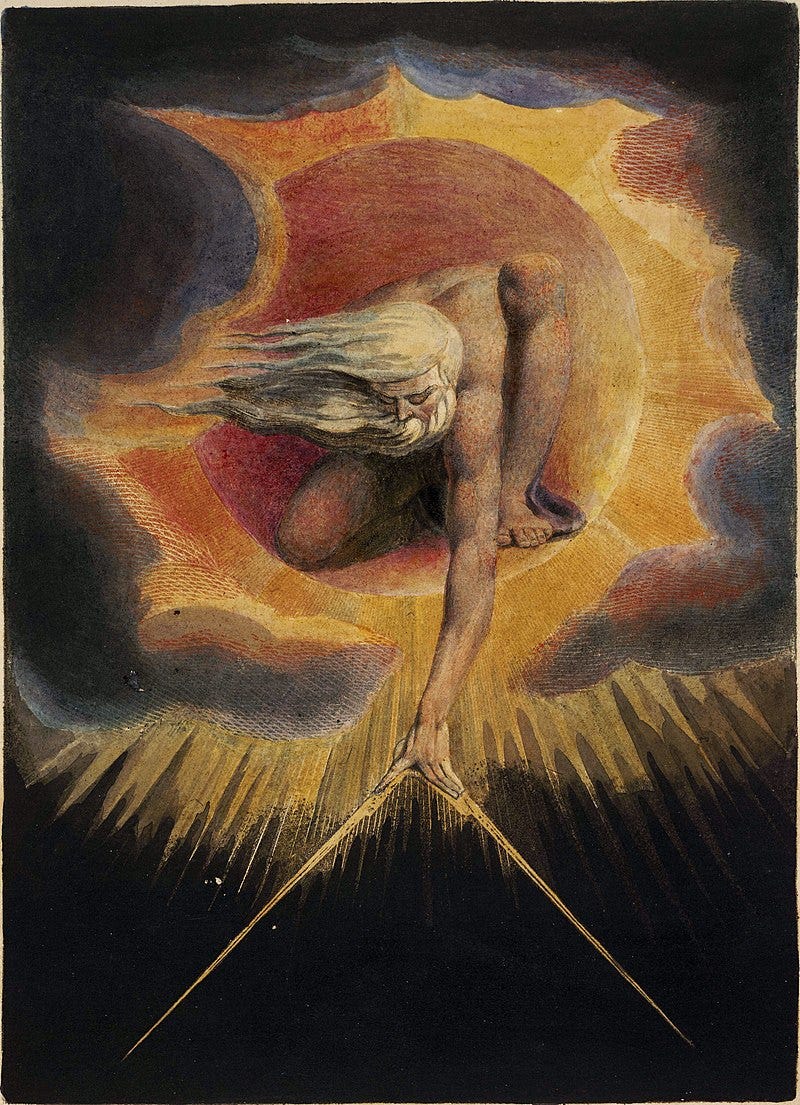
The Ancient of Days by William Blake
And it’s always a him.

If God is a craftsman, crafting a cosmos, then God must be less than Godself + God’s craft + the God-sized room within which God crafts, thus not God.

Here’s my take: God is the Infinite. The that-than-which-nothing-greater-can-be-conceived. The Alpha to Omega, A to Z, First and Last, the Beginning and the End.

God is before all things, and in God do all things consist. All things live and move and have their being in God. Everything that is, is in God, and there can be nothing outside of God. When I speak of God, I mean the single, infinite substance that constitutes the universe. If this sounds like Spinoza’s God, it more or less is.

Objections

But this God isn’t personal.

God is not a person, but that does not make God impersonal. God is not less than a person. God encompasses every past, present, and future person. So, insofar as God can be known, God can be known personally.

Because God is the sound of a tree falling in the forest; real when I hear it. God is personal when I engage in a personal relationship with God.

We make personal relationships with everything, even when we don’t mean to. When I trip on an uneven sidewalk, the stone is malicious. When I’m stuck on the highway, the traffic is evil. And this isn’t totally irrational. Consciousness must be as natural to the universe as magnetism or the strong and weak nuclear forces. Empathy (and anthropomorphism) is consciousness attempting to recognize itself. There is love here.

So, since I am a person, I crave a personal relationship with God. Religion is a way to intentionally, specifically, and skillfully cultivate a personal relationship with God. There are others.

This isn’t the God of the Bible.

The Bible does not present a unified depiction of God (thank God). Paul understands God differently than Jesus, who approaches God differently than Moses. Origen would not have agreed with Augustine who would not have agreed with Calvin or Darby or any Christian alive today. Every theologian has understood God differently, despite common heritages. This is not (necessarily) a problem.

The Bible is not a science text or a user’s manual. It is a library connecting today’s living faiths with their ancient roots, buried deep in inaccessible history. Its purpose is not to declare facts about God, but to show the depth of our inheritances and inspire us to grow forward from faith to faith, glory to glory, preparing the way for something amazing. To confess Christianity is to take our place in this ever-changing Body of faith and practice.

The Bible has its proper place in my faith: a Godsend, and useful for apologies, gospels, rebukes, and encouragements: so that the religious practitioner can be skilled and equipped for every good work.

Why Christianity?

It is my inheritance, and my children’s after me. Years of practice gave me a rather particular set of spiritual skills. Prayer still lets me talk to God, hear God, and reaffirm my best aspirations. Worship still fills me with joyful holy awe. Scripture still provides spiritual meat and drink. The Father still hides in unapproachable light. The Son is still present in the eucharist, the Body, and myself. The Holy Spirit is everywhere. You say no one is listening when I pray? I listen. And, beyond these clinging aggregates that I call myself, who knows what sapience is privy to my devotional utterings?

A Christian God

The Trinity is one of the oldest and most controversial mysteries in Christianity. Here is a way of understanding the Three-in-One:

God is Father (the Almighty)

The eternal, immortal, immutable, invisible God, sustaining the universe through the Word of His Power. God the Father is no less than the unapproachable, unchangeable laws of nature that govern the universe. The founding principle of reality. The prime substance from which all things proceed. The consistent, unalterable nature of the universe.

God the Father is unknowable, and yet I want to know God. I see something when I stare at the abyss. I hear a sound when the tree falls.

God is Son (the Word)

That sound is the Son, the image of the invisible God, the Word by which the universe comes into being. The Son is firstborn of all creation—begotten not made, co-eternal with the Father—who died and lives, forevermore. The expression of the Father, the Laws of Nature in action. If the Father is the Game, the Son is the game being played.

According to my scriptures, Jesus of Nazareth was declared to be the Son of God in power and taught his followers to likewise call God Father, becoming the eldest of many siblings. His death and literal resurrection in the people who abide in him, the Body of Christ, is one of the great mysteries that Christianity peeks into.

God is Holy Spirit (the Paraclete)

The Holy Spirit could be the biggest mystery because She’s the one by which we speak about God. Like thinking about the mind or looking at the eye; it’s hard to use a tool on itself.

The old creeds say that the Ghost proceeds from the Father, or from the Father and the Son. Jesus calls her a comforter, advocate, or helper. She tells prophets and poets what to say. She opens minds and regenerates hearts. She’s the wind that blows where it wishes, carrying us along. I think God the Holy Spirit is the infinite interplay of relationships arising from the Father and the Son. The manifestation of God’s immanence, the substance of the connection between all things on all levels. This is a mystery.

God is Love

The universe is not cold, uncaring, or trying to kill us. The Earth is a perfect fit. True, not all of it. And yes, the vacuum of space is painfully lethal, but we didn’t emerge there, did we? Despite the ways we have marred it and the fact that death comes with life, this world is friendly. The sky pours water and the earth produces food. The sun gives us warmth while gravity keeps us stable. Behold this gorgeous flesh we inherit, full of sensors that light the universe with taste and touch and sight and sound! What do we call this but the love of God?

It is right to rest in the benevolence of God because God brings me into being and keeps me that way, until this form returns to dust, making room for more of the life that God loves.

Final Thoughts

It might seem like this deconstructs God into meaninglessness. I understand if you feel this way. I would never try to supplant someone’s idea of God with my own. That’s an aggressive idolatry.

But my devotional life has flourished with this perspective. If you find it hard to believe in God today, maybe this is a good place to start.

Religious, but not Spiritual

I get confused when people say they are spiritual, but not religious.

I don’t know how you can do spirituality without religion. Religion is like scaffolding. Both the five-hundred-year-old tradition and the vague conception of following your own inner truth are religion. Religion is the structure, the ritual, the lens through which you see parts of the world.

I think I’m religious, but not spiritual.

“What does that even mean?”

I pray and read the Bible. I belt out hymns and attend church. Christianly myth undergirds my interpretation of reality. I love sacred things. I’m religious, and I can’t help it.

But I don’t think any of the stories really happened. I don’t think the Bible is a book from God, and I don’t think that Jesus rose from the dead. I don’t think anyone is listening when I pray, or spiritually leading me, or that I’ll survive my death in any meaningful way. I’m not spiritual. I believe in the sacred, not the holy.

The Bible is sacred, foundational to many religious frameworks. But it is not holy. It is not whole and pure and uninjured. It is a collection of disparate works across time and genre that do not internally cohere without a complex hermeneutic formula. If I believed it was holy, I would have to accept the obviously evil bits of the Bible.

Here’s a guy who’s religious AND spiritual

A benefit of being religious but not spiritual is that I can hack my religion. Since it’s not the eternal edict of the universe, I can toss out every word of the law that contradicts the spirit of love and, with a nod to Marie Kondo, every doctrine that does not spark joy can be reverently discarded.

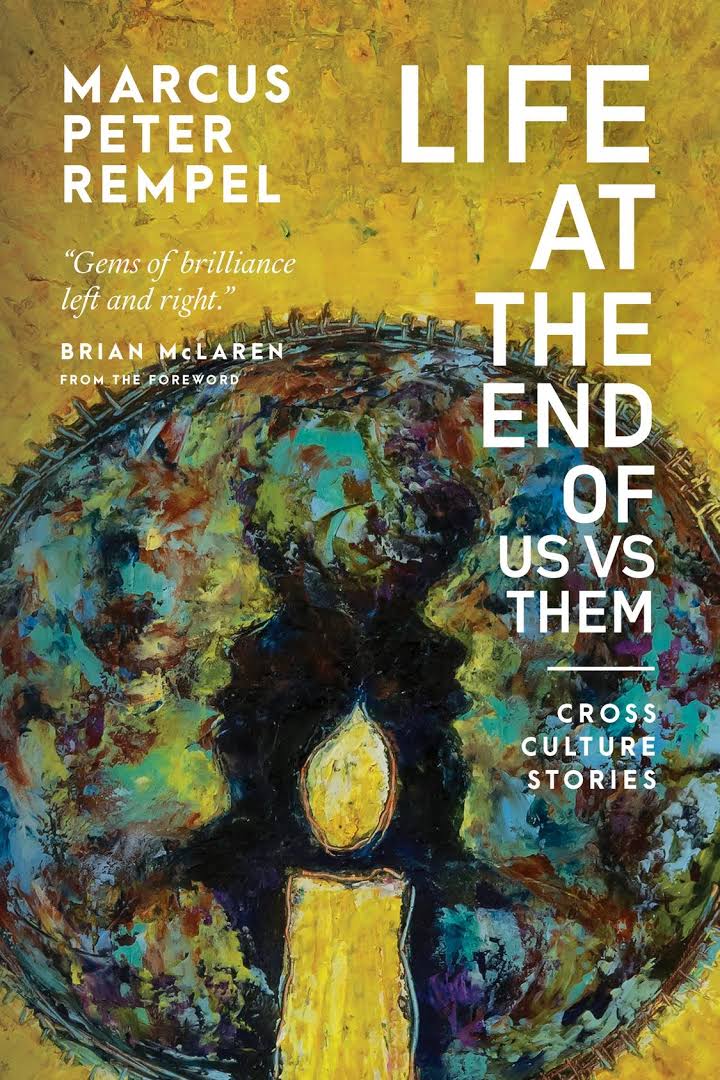
Christianly Book Review: Life at the End of Us Vs Them by Marcus Peter Rempel

images“The warnings I offer here do not come out of a superior religion but out of a failed religion

Marcus Peter Rempel’s book, “Life at the End of Us vs Them,” is a seriously thought-provoking view of Christianity and its place in our “strange, endtime world.” Drawing on René Girard and Ivan Illich, Rempel presents a view of the Cross that necessarily undermines any power structure that would try to build on it.

The crucifixion of Christ, he argues, is not best seen as a judicial act of substitutionary atonement. Instead, it is something like God identifying with the most marginalized individuals, the most hated outcasts, the people who society crucifies. “It is by taking on the viewpoint of those it marginalizes that Cross-formed culture comes to be accurately mapped, and more justly remade” (13). Rempel takes this understanding, and applies it to his relationships with “those who are his other: women, queer folk, refugees, Muslims, atheists, and Indigenous people.”

Here’s what I like about this view of the Cross: it reminds you of everything at once. It reminds you that you are part of the system that crucifies innocents. At the same time, it offers to forgive you. And it bids you pick up your cross, and follow in that way of looking at the world–that the “least of these” is, somehow, the Christ. It shifts the view from Us-Them to I-Thou. Frankly, it reminds us that Jesus never meant to convert the world. Yes, he meant for his Way to go out into all the world, but not to colonize it. Not to become the oppressor.

The Cross will always glare accusingly at any system or person that tries to use it as a tool of oppression. It undermines all sacred violence. It perpetually strips the sacred cloth from the temple, showing it to be empty. The violence we thought we did in God’s name was actually against his own son. All persecution persecutes the Christ. Christianity as a religion, Rempel argues, has failed insofar as it has been complicit in violence.

At least, that’s how it could work. From what I read on the Internets, I don’t see a reconciliation between Church and the vulnerable anytime soon. If it’s possible, though, for follows of Christ to sit with the very marginalized instead of always being seen beside the oppression, this book gives clues on how it will be done.

I heartily recommend this book to people who want to take the Bible seriously and are troubled by the dissonance between Church and Christ. If you believe that substitutionary atonement is the only correct way of understanding the Cross, you will probably balk at a lot of what Rempel has to say. Consider, though, that both Scripture and Church have cast the Cross in different lights to glean fresh insights from that wonderful tragic event. Rempel offers a light that the Church today would do well to meditate on, even if she can’t swallow the whole thing.

A Christian and Two Ex-Believers in a Pink Room

Ruth and I sat down with P.J. Tremblay, A.K.A. P’Jamz. We all met at Bible college a couple life-times ago. We had a great conversation about the faith and losing it and keeping it and how we can all start to speak the same language.

P’Jamz recently released his an LP, Foibles & Fiction. Songs like Proud and Odd One Out candidly talk about the fallout from losing faith. Go to his Audio4n6 Site to check him out and buy his album.


Sit in on our conversation on the Audio4n6 channel. There’s a lot here, and it’s been split up into convenient little chapters:

Part 1 — How we all got to Bible college

Part 2 talks about evangelism and missions

Part 3 — the uses and abuses of Christianity

Part 4 talks about what it takes to be successful at religion

Part 5 — how if religions don’t change, they don’t endure

Part 6 makes Ruth choke on water

Part 7 — childlike curiosity

Part 8 reminds us there are a few things to keep

Part 9 — the power religion can provide

Part 10 talks about how hard it sometimes is to talk about this stuff

Conversation with Derek Webb

Derek Webb’s music has been important to me since 1999. Songs like Not the Land and Wedding Dress provided vocabulary for aspects of my spiritual journey that other believing artists wouldn’t touch. Faith My Eyes and Lover were soothing anthems during my missionary days. His most recent album, Fingers Crossed, is a tale of spiritual and marital divorce. It’s about losing faith and family. It’s sad and beautiful and if you’ve ever lost faith go listen to Goodbye, for Now and cry a bit.

I sat down with Derek last week at before his house show in Buffalo. We had a great conversation about his music, what’s left over after faith is gone, and the time he nearly killed RC Sproul. Watch the video below, or at Youtube where there are handy chapter divisions in the description.

Go buy Derek’s music and tickets to his few remaining house shows at derekwebb.com

Morning Devos: Seeing God’s Floor in Exodus 24

One day, at the mountain, God tells Moses to bring the ruling class of Israel up for dinner.

And they saw the God of Israel: and there was under his feet as it were a paved work of a sapphire stone, and as it were the body of heaven in its clearness. And upon the nobles of the children of Israel he laid not his hand: also they saw God, and did eat and drink. Exodus 24:10-11

Imagine one of the nobles, coming home after supping with God.

“What was He like?”

“His floor was…so blue. Clear as the sky.”

“But what was He like?”

“He didn’t lay a hand on me.

“…”

Big revelations and encounters cannot be easily put into words. We resort to phrases like, You had to be there, when the story doesn’t hit our hearers the way it hits us. This is probably why most worldviews, besides your own, look trite or foolish or just plain wrong.

Reality created itself by accident? That’s just stupid!

A deity with an elephant head? How silly!

God kills himself to stop himself from killing us? Give me a break!

A dinner party with Yahweh and a shiny blue floor? What a fairy-tale!

Every meaningful experience has something in it that is ineffable. When we meet something real, sometimes the only thing we can put into words is the floor.

And, man oh man, it was clear as the sky.

Palm Sunday Report

It’s Palm Sunday today and I’m a quarter through my year of living christianly. Here’s some observations:

  • It wasn’t hard to lay down a habit of waking early and spending decent time in meditative reading. The habit has opened my mornings up, and it feels like there are more hours in the day.
  • The first few months were emotionally intense. This is a deliberate understatement. I never felt such sadness and anxiety before, though I could sense a healing thread in it all. I think I had to properly mourn my loss of faith a while.
  • I can sit and chew on a piece of myth or devotional reading without believing that any of it actually happened and still find worthwhile nuggets to carry with me and change mt outlook on life.
  • I haven’t been to church for about a month. I’d like to blame school and term papers, but the fact is, church is meant to be a community of like-minded spiritual pilgrims. It grows hard to sit as an outsider. I’ll be back, though.
  • Digging into Scripture and dense spiritual literature is invigorating. I’d forgotten.


Tea with the landlord

Kunri, Sindh.  2006

Our landlord lives in the flat below us. He invites me over for tea in the evening, after the nap. His place is nicer than ours. I like ours better, though. We have the roof. It’s one of the biggest buildings in Kunri—three storeys. And the high walls on the roof make it look taller, though they do spoil our view.

I sit with my landlord on the charpai. His English is good, and I’m grateful. I’ve only been in Pakistan a year and Urdu still makes me nervous. We talk about all sorts of things. He asks me about my family. He asks me about Canada. Strange, I don’t seem to ask him much.

He brings up religion. They always do here. I’m eager on this subject. I take control. I make my argument. Tight and powerful. I show the weak spot in his (what shall I call it?) cosmology. Proved. Done. QED.

But he doesn’t get it. He has no answer, but he is unconvinced. Seeing that the stakes are raised, he throws his own attack at me. It’s nothing I haven’t heard before. Nothing I haven’t thought of before. It doesn’t faze me. I have no answer to give him, though. And the look on his face tells me he thinks he’s won something.

The conversation moves on, I suppose. I hardly notice. If only I’d had more time, I could have told him something clearer. Something that would have helped him see what I see. It’s just so obvious from my side, and I can’t understand why he can’t see it. He’s not an idiot, after all. I wonder, as we shake hands and I turn to go home, if he is thinking something similar about me.

I don’t sleep much that night. It’s hot. My bed is on the roof, nuzzled by winds that have been gentled by the high walls. I stare at the stars and ask my silent God to sow a seed in my landlord’s heart. To crack the hard shell of his delusion.

At least as much as he’s cracked mine.

My Journey #1 – Purpose

Sept 29, 2013 015(2)

My name it Matt. I used to be a Christian. I’m not anymore, and I want to tell the story about how that happened.

Topics like these are controversial because most of us are intensely invested in our worldviews. It would be easy to misunderstand the purpose of my telling.

I am not telling the story to defend myself. As an evangelical I would never have been convinced to justify the moves of someone who left the faith. If there was no spirit of Christ, it did not matter how heavy the evidence or profound the experience. No Christ = no good. So I know that no one from where I’ve come from will be able to consider my path as legitimate. I understand that and I don’t begrudge it. I did the same when I heard of brothers and sisters who abandoned Christianity.

I’m not telling the story to draw anyone away from their own faith. Jesus gives the world one of the most powerful ethics I’ve ever seen. If everyone were to adopt his way of doing life, we would have world peace tomorrow. Sure, his ethic generally takes a backseat in the lives of his devotees, but every once in a while someone appears in the Church that takes Jesus’ way of life seriously, and the world is better for those people. I’d hate to pull someone away from that.

Part of the reason I’m telling the story is that everyone wants to be understood. It sucks when the people you love don’t understand you. It sucks when they look at your path, with all its complexities and struggles and nuances, and write it off without understanding how it all happened. And even though I know most of my friends will not understand even after I’ve told my story, heck, at least I tried.

The next four posts will highlight the major signposts in my journey. It is all from my perspective, because that is the only perspective I have the right to speak from. Take it as that. Or don’t. I don’t care, in the end. It is enough that I have had my say.

Ruth’s Last Word

One more guest post from Ruth.  Because she’s got things to say and I’m really tired.

So, as you can imagine, we’ve gotten a lot of emails this week. I’m sure each and every one of them was sent with a spirit of goodwill, but certain spoken/unspoken aspects of the communication have gotten me down, and I’d just like to express my feelings about them.

We have been married for more than nine years. Over this time we’ve developed a very special relationship. And not just in the normal way all relationships are special. I mean there is something weirdly uniquely special going on here that basically overcomes and destroys all joy-stealing obstacles in our path. Matt has changed over the years, but the thing that has not changed even the tiniest bit is that strange, wonderful relationship. I get the impression from others that our relationship is expected to suffer because of the different ways we view the world now. That sounds like a cop-out. Relationships suffer if the people in them are willing to let them suffer. There’s no other reason for it at all. In our situation, there is no obstacle to our walking together in perfect harmony, in spite of our disagreements. Matt’s different views have not turned him into some strange, new bizarro Matt.

There’s another idea that floats around the church that if you hang out with people who are outside the church you may get pulled along with them. But if someone’s faith can be injured by the people they hang out with, what kind of faith is that? Is that the life-transforming power of the Holy Spirit the Bible talks about? I’ve never understood it when people try to avoid ‘bad people.’ The ‘others.’ The ones who are on the ‘outside.’ I’ve never understood it because those are the very people that Jesus hung out with the most. Matt encourages my faith. He’s never tried to impose his views on me, even though we often have lots of discussions about those high things.

And, lastly, I appreciate everyone’s prayers, but don’t be sad for me. I’m quite happy. I have the Three Things: Faith, Hope and Love. The best is Love.

PS – I love you, Matt