Matt W Cook

writer.former fundamentalist.christianly fellow

Satan’s Empty Badassery

Satan is so bad-ass in the first book of Paradise Lost. He wakes up in hell and struts out the pithiest of sayings. Like,

Hail Horrours, hail
Infernal world, and thou profoundest Hell
Receive thy new Possessor: One who brings
A mind not to be chang’d by Place or Time.
The mind is its own place, and in it self
Can make a Heav’n of Hell, a Hell of Heav’n.
(Bk. I, 250-255)

Boom! Drops the mike. On he goes, immutable God of his own internal state, right?

But when he leaves hell and the fawning gazes of his co-conspirators, he has a moment where he is more honest with himself. He gets depressed, surrounded yet untouched by the awesomeness of Eden, because

within him Hell
He brings, and round about him, nor from Hell
One step no more then from himself can fly
By change of place
(Bk. IV, 20-23)

And he eventually realizes,

Which way I flie is Hell; my self am Hell;
(75)

Poor devil. He thinks his strength is in a mind that refuses to change. But a mind that cannot change is unnatural and ill-fitting in a world where change is the only constant. He is right that the mind is its own place. But the mind that refuses to change will more likely turn heavens in hell.

With the Sufis in Toronto

Back when I was a religious man, a dear Sufi friend invited me to his prayer and meditation group. Many religious people try to avoid too much exposure from the competition, and I couldn’t blame them. We grow up with stories about unwary sheep stolen by wolves. But I rarely entertained fears that my faith could be destroyed. I believed either my truth was unshakeable and therefore priceless, or else it would prove vulnerable and I could dig deeper to find the unshakeable.

Featured imageWe met in a family apartment, and even though my friend hadn’t told the others I was coming, they didn’t bat an eye at me or my flashy yellow tie. I joined them with a guileless heart, open to whatever wisdom they had for me.

We recited mantras and slipped kidney beans into little bowls. We meditated on the colour blue with our eyes closed. We heard a woman’s simple sermon on love. I stayed in the house of the Sufis for hours, talking about Pakistan, love, and the price of mangoes. But mostly about love.

My faith shook and fell apart some years later and at first glance you’d think it was the foundational things that crumbled. But it wasn’t. The things we call foundational are usually just distinctives–the things we believe that separate us from them: Which books to trust, if any. Which prophets to venerate, if any. Which creators to call on, if any.

It’s hard to touch the fundamental parts of spirituality because of the clutter we surround them with. But the most solid things are deeper than mantras and kidney beans, richer than bread and wine. They are surer than scripture and reach further than prophecy. Those gentle Sufis knew the fundamentals and here’s the proof: If everyone in the world had their same heart, their spirituality, the kingdom of heaven would be here already.

That Damned NEW331 Essay

You know when you’re working on that essay for the third-year course that’s so heavy you think it’ll crush you? The one that makes you think this was the wrong path for you after all. Maybe school is just a big black hole that’ll suck you in and squish you and never let you out again. It makes you think about the night-job you left for school. Maybe you shouldn’t have left–the pay was good and the people were great, why did you ever leave it anyway? I mean, look at this ridiculously vague topic! Look at the huge wordcount that’s expected! And fifteen independent scholarly sources? No one is even studying what you’re supposed to write about! Not only that, but the professor has this air of impenetrable rigour about him–this is no humanities paper where original ideas and good spelling will get you a half-decent mark. No, no, he wants science from you. What do you know about science?! So as the deadline inches closer without your rough draft growing much larger, the weight of expectation seems to crush you.

But you’re a faithful one, in your own way, aren’t you? You fiddle with it every day, even though it hurts. You’ve got some experience in faith-walking, so you study and write and attend lecture, tearing only a bitof your hair out along the way. You might not get anywhere, but what else are you going to do?

Until you turn the Corner and a bright light appears within your mind. You get it. The rest is cake.

Why didn’t you see it before? Why were you so confused and crushed by something this…understandable? Maybe confusion and crushing lead to understanding. Maybe you were always going to grow this thing eventually–sweat for water, discipline for sunlight. Twenty bucks says that a gentle and calm spirit would have been nice fertilizer, but hey, maybe next time.

And isn’t it funny that nearly every good venture works the same way as that damned NEW331 essay?

Up in Smoke

There was a time when I just could not stand it. It was as if there was a burning pit of death in my chest that I did not have the endurance to keep carrying. People tried to encourage me with words. “He never gives us more than we can handle,” some said. I wanted to scream back, “Liar! Look at this thing I carry! Look at this amazingly effed up situation I’ve been forced in! You don’t know what it’s like! And even if you did, that does not help at all–words are wind blown from open mouth-holes. How could words help me? I cannot handle this!”

But, of course, I did handle it. I’m still here, after all. I guess it was all in my head.

That’s not totally true, of course. There was something real going on in my life that sparked the suffering. My thoughts were, “If only so-and-so were never in my life! If only so-and-so hadn’t done this, or that, or whatever! Then I’d have never lost my peace.” But that’s a half-truth only. And not a useful one, at that.

Suffering and peace only exist in my own consciousness–in my head. It was important to realize that, because it gave me the opportunity to deal with me, even if I could not deal with the situation.

I took the hand of the Beloved who suffered along with me, and together we made a list of the things that our death-like anxiety sprang from. They fit on a small slip of paper. We looked at each item, mindfully and in turn. They were not so heavy now, on that thin scrap. It seemed like we could fight back. So we set them on fire, and laughed at their fragility.

The fire-ritual didn’t change our situation, of course. The people who were actively trying to rob our peace continued their thievery. But we created distance and glimpsed into the truth that it’s all, at the end of the day, in our heads. And I get to choose what dwells in my head. The trials changed over the following months and years, and today I cannot remember what it was that destroyed my peace so utterly. Life goes on, everything changes, and the crises of today will always go up in smoke.

Guest Post – News from i117

Hello friends!

It’s that time of year again–no, not Halloween. Widow’s Christmas Party!

In all the busyness of life it’s easy to forget about the hardships of people on the other side of the world. All the little things that make life in Canada comfortable and ‘safe’ tend to clutter up our attention. It is hard to keep the poor in mind when our hands are so full with work and school and kids and Halloween parties and whatever else we fill our lives with. Our goodies distract us.

Our widow friends have started to ask if the gathering is on for this year. I want to say ‘yes!’ And I want you to be a part of that ‘yes!’

With $600 we could throw a great party for these marginalized people of Sindh. Like each year, we will feed them, give them gifts of much-needed supplies and clothing, and share the love of Jesus. It’s a small sum of money that can be turned into a huge sum of love.

If you’d like to take part, go to i117’s Paypal site. Or message me through Facebook or e-mail.

“Then the King will say to those on his right, “Come, … For I was hungry and you gave me food, I was thirsty and you gave me drink, I was a stranger and you welcomed me.”
– Matthew 25:34-35

Lord Greer Builds His Own Tomb

The expedition had taken its toll. Lord Greer delved deep into the far reaches of his kingdom, painstakingly setting his eyes upon every desert, every mountain peak. He had hardly noticed the pains, then. His eyes had been filled with sugar-coated dreams of grandiose map rooms. He dreamt of walls covered with maps of cities, provinces. One grand map of the Nine Provinces, woven together as one. He sent the Cook, recently elected mayor of Lower Celestrome, to Eastwatch with an edict to subdue, pillage, and map those realms. Lord Greer himself looked toward the north.

Perhaps he had been hasty. Perhaps he should have waited for a better horse.Zet5nji

The first horse bred for Lord Greer had been a midnight charger, valiant in speed and smirk. It died in a tragically avoidable creeper mishap. His second horse was a dappled mare that suited well for a time, though it was not as fast as the charger. It died somewhere in the City of Celestrome, and was never spoken of again. The last of the tamed horses was hardly worth his Greer’s Lordship. Slow and of ill health it was. Posthumously named Le Miserable.

For three days did Lord Greer drive his Miserable through hostile wilderness, filling his delicate maps with the joyous sweetness of information. Nights were no danger, Lord Greer thought as his hunger grew unnoticed. He kept moving all night long and his enemies had but time to turn their heads as he trotted by. Vast mountains and arid deserts and fruitful swamps were all claimed under the ever-reaching banner of Celestrome. Until he came at last to Lear’s Forest.

Night had fallen. Oak and birch grew cheek by jowl. Lord Greer began to notice his hunger. It threatened to sap his admittedly prodigious strength. But his maps were nearly full, and beyond this forest, he knew, was the northern wall of the City. Home and a hearth. Food and empty crates waiting to be filled by the goodies crammed into his saddlebag. He only had to get through the woods. He pushed Le Miserable as hard as it would go. His head was perpetually stuck in tree branches. He could have gone faster had he been on foot, if he had had the strength to run.

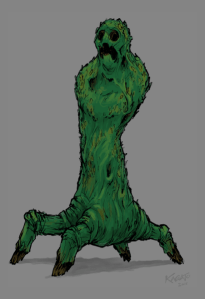
Then he heard it. The familiar tapping of bone on bone. The pained growl of the undead. He was not alone in the dark woods.

He tried to force Le Miserable into a gallop. Then his head struck a block of foliage. He was ignobly thrown to the ground in the passive voice. Getting to his feet, he saw Le Miserable rearing in fear and panic. The green men and the walking bones drew close for the kill. Lord Greer pulled his shining sword from his sheath. With a fearsome, “Ho!” and “For the glory of the radiant kingdom!” he attacked the undead.

Gentle came the reply, whispered on winds of malicious intent: “Shhhhhh.”
studiokagato.deviantart.com

The forest exploded in a flash of light and pain. Le Miserable’s sufferings were put to a merciful end, and the undead were disoriented. But, oh, the blood which flowed from Lord Greer.

He crawled away from the battlefield, but where was he to go? The forest was vast and the night, full of terrors. Each way he turned the voices sang their dirge from behind the trees. An arrow struck the oak behind the great king, and his bowels loosened in terror. He turned to run, and a green man mauled him with a rotting fist. He fell back, and was forced against a tree. Too weak to fight so many foes, the inventive king prepared to build.

He threw cobblestone around his feet, above his head. It bought him time. Arrows embedded in the walls. Green men reached in vain. His roof blocked out the moonlight. In the dark, he looked out the last window and paused for a final moment to look at the stars. In that instant, a bone man loosed an arrow. Sent from a fel bow, yet did it fly true. It struck the Lord Greer. And the dark death swept over his eyes.

No one ever found the body of the king, though many did look in both rain and sun. There was no one to bury him. But no burial was needed. Lord Greer had built his own tomb.

Koheleth on Finding Something for My Hand to Do

There are Many Things I’d like to write about today. And most of them are rather large.

I’m writing an epic fantasy trilogy about faith, love, and zombies.
I’m writing a sci-fi novel about interstellar wormholes and MMO empires.
I’m writing a novella about a girl growing up in a place that hates what she is.
I’m writing a short story about subterranean Olympians.

Dore_Solomon_ProverbsWith Many Things comes Choice. And Choice asks me, “What do you feel like writing?”
It’s a devilish question. I can’t figure out what I’d like to do. Every moment of my life I have fleshy urges that push me in one direction or pull me from another. When I ask that question during writing-time, it does little more than distract.

Then I remember what Koheleth said about it:

“Whatever your hand finds to do with your might, do it.”

That reminds me that whatever I find to do, I might as well do it. But there’s another way to translate that line:

“Whatever your hand finds to do, do it with all your might.”

That reminds me to see whatever it is trough to the end. And the conclusion reminds me of the stakes:

“Because there is no working or planning or knowledge or wisdom in the grave to which you are going.”

One day I won’t exist, like I didn’t before I was born. So I might as well do something, and do it well, while I have the chance.

A Few Lines on a Warm Afternoon

I am not just lying, stretched out under this tree in the warm afternoon of early autumn.
I am not just listening to the ever-unique chatterings of birds and squirrels who argue and flirt with each other in the branches.
I am not just breathing this air made fragrant with the warm decay of the shifting season.
I am not just watching the leaves as they lose their delicate grip to tumble down and rejoin the dust they sprung from.
I am not just drifting in and out of idle thoughts and half-dreams this sleepy afternoon.

10157401_10152813143161992_3743964323157054863_n

I just am.
And I don’t need a photo
or a sketch
or these words on a page to make it so.

Even so,
I write the words
and slip a leaf into the brim of my hat
as I slip off to my next class.

Can’t Save the Game

I was starting up the nightly Minecraft game. I flicked through the options and asked which texture pack we should use. Asha asked for the Plastic pack.

“Can’t use that one,” I told her.
“Why not?”
“It’s just a trial pack. We won’t be able to save what we build.”
“I don’t care.”
“But anything you make will be gone when we exit. Forever.”
“That’s okay,” she said. She was willing to spend her unredeemable time building something awesome, and then walk away and let it cease to exist. It reminded me of a couplet from the Bhagavad Gita:

You have the right to work,
but never to the fruit of work.
2.47

Sounds awful, doesn’t it?

At the end of the day, though, that’s just how it is. And not just in the obvious sense—that often we work really hard for something we don’t get. That’s how it is in a bigger sense.

I want my life to matter. We all do, I bet. We work hard to matter. We draw attention to ourselves and train long hours and take crappy jobs to make our mark. But no mark we can make will last. A billion years from now, nothing that I have done will remain anywhere at all. I build my castles, but when it’s time to quit, I cannot save the game. Seems depressing, eh?I-have-arrived-I-am-home

But not to Asha. She isn’t concerned about the fruit—saving the game. No, the game is in the building. She hasn’t learned that she’s supposed to suffer and strive and sacrifice today for a tomorrow that never seems to come.

I hope she never does.

Idea Wisps

smoky wispsThey come to me all the time. I bet they come to you, too. Washing dishes, on the bike, cooking. A few magical wisps of a scene appear. A few exceptionally clever lines. An original plot that just begs to be allowed to grow.

I hold it in my head as hard as I dare while finishing the dishes—I’ll crush it if I crumple it too hard. And it seems intact when it’s done. Until I try to type it out.

I can’t seem to lead into it. It’s just a wisp or a few lines or a general plot. It has no context. No place to attach itself. Like a single atom, which cannot exist unless bonded with something else.

So I shake my head and smile as the wisp floats away. I don’t begrudge its uselessness. It was fun to think about. Fun to chew over. And I’ve also noticed that when the wisps are breezed away on the wind, they leave a scent that never seems to go away.